


A port agency quotation can look simple when it lands in the inbox.
You have the vessel, port, ETA, and services. Then the real work starts. Someone still has to check vessel particulars, tariffs, terminal charges, vendor pricing, client rates, currency, berth assumptions, and any details that are changing as the call develops.
When that information lives across old jobs, PDFs, spreadsheets, inboxes, and vendor conversations, the quote can take far longer than expected.
In this blog, we will look at why quoting takes so long for many port agencies, where that time tends to go, and how Base helps cut down the admin around the process.
Why Port Agency Quoting Gets Complicated So Quickly

Here are some of the common issues we see when port agency quotes start taking longer than they should.
Some come down to how information is stored and retrieved. Others involve rate checks, vendor coordination, or details of the call that are still changing. Each one adds work to the quotation process in a different way.
Let’s look at where that extra time tends to come from.
1. Much of the Information May Already Exist
A vessel may have called the same port six months earlier, and the agency may already know the principal and most of the local vendors involved.
Useful information can still be spread across several records.
The previous PDA may show the last pilotage charge. A newer tariff may sit in a shared folder. The launch provider’s current rate may be in an email. Vessel particulars may be attached to an old job.
Historical records also need context. The last call may have used another berth, a different service scope, or a tariff that has since changed.
The agent needs quick access to that history so the review starts with the right context.
The same principle applies when work passes between people. A good port agent shift handover gives the next person the current vessel status, decisions, rates, and outstanding actions without requiring another search through old messages.
2. Finding a Rate Does Not Mean the Rate Is Ready to Use
Rate retrieval is only one part of the pricing work.
A port or terminal charge may depend on GT, NT, LOA, draft, berth, number of movements, working hours, or another condition of the call. A principal may also have agreed pricing that changes the amount used in the quotation.
The agent may need to check the current tariff version, confirm the expected berth, review overtime rules, or establish whether a contracted rate applies to the requested service.
Those details affect the quality of the quote.
Good port cost management starts here because the estimate depends on the quality of the rates and assumptions feeding it. A current tariff and a clear client agreement are more useful than another copy of last month’s quote with no context around the numbers.
3. Vendor Pricing Creates Its Own Timeline
Some services require current vendor pricing.
A launch operator may need to check availability. A transport provider may need the pickup location and timing. A waste contractor may need the quantity or waste type. A tug company may need vessel particulars before confirming a rate.
The quote may pause while those responses come back.
If several vendors are involved, the agency also has to track who was contacted, which replies have arrived, what each response includes, and how the prices compare.
A vendor response may arrive as an email, PDF, spreadsheet, or message with a few lines of pricing buried inside it. Bringing those answers into one commercial view becomes another step in the quotation process.
4. Some Parts of the Quote May Still Be Moving
Port agency quotations are often prepared while the call is still developing.
The berth may remain provisional. The ETA may move. The vessel’s draft may change. A terminal may issue new instructions. A service planned for normal working hours may move into overtime.
Those changes can affect the price and the wider port call turnaround time. An ETA change can move a vendor window. A berth change can affect a tariff line. A delayed arrival can change transport, launch, or staffing costs.
Quotation work therefore needs enough flexibility to absorb changes without requiring the commercial record to be rebuilt every time the operation moves.
Research into the digitalization of port call operations has examined similar coordination issues, including the problems created when operating information moves across disconnected parties and systems.
What’s Happening During a Port Quote Turnaround?

A port quote usually passes through several distinct stages before it reaches the principal.
Looking at those stages separately helps show where staff effort is going and which parts of the turnaround depend on outside parties.
| Step | What Is Happening | Type of Time |
|---|---|---|
| Review the request | Understand the scope and identify missing details | Judgment |
| Gather vessel and call details | Pull vessel, port, berth, principal, and previous-call information | Mostly administrative |
| Check tariffs and existing rates | Find current rates and determine which ones apply | Judgment + administrative |
| Request vendor pricing | Prepare and send vendor requests | Mostly administrative |
| Wait for outside confirmation | Receive vendor, berth, terminal, or principal responses | Outside waiting |
| Review and validate costs | Compare pricing and check assumptions | Judgment |
| Calculate currency, fees, and totals | Apply FX, taxes, fees, and markups | Mostly administrative |
| Prepare the quotation | Build the client-facing quote | Mostly administrative |
| Final review and send | Check the scope, numbers, and assumptions | Judgment |
The key difference is what the agency is actually spending time on.
Some delays come from waiting on a vendor, terminal, or principal. Others come from internal work like finding rates, comparing responses, calculating charges, or preparing the final quote.
That distinction helps show where port agency software can have the most impact: reducing the staff time spent on repeatable administrative work around the quotation process.
How Does Software Help Cut Time Out of Port Agency Quotes?

Software like Base can reduce the amount of staff time tied up in the administrative side of quoting.
Base keeps the vessel, port, rates, vendor responses, charges, and client information connected to the same job so the agent has one place to work from as the quote develops.
That shows up in several parts of the process. From turning a nomination into a structured job to comparing vendor bids, pulling known rates, handling currency, and generating the quote itself, Base is designed to cut down the repeated lookup and re-entry that can drag out quotation work.
Here are the main ways Base helps you shorten quote time:
✓ Start the Job Without Rebuilding the Nomination
A nomination often contains information that would otherwise need to be entered into an internal job record before quoting begins.
Base can turn a nomination email into a structured job in under 60 seconds, bringing the vessel, voyage, port, service scope, and other available information into the working record.
The quote therefore starts from an existing job rather than a blank file.
✓ Keep Vessel and Port Information Available
Base keep vessel and port records available inside the job.
Known particulars can be reviewed from the same record used for the quotation instead of being pulled from an old job, questionnaire, or separate database every time a request arrives.
That gives the agent a consistent starting point for the call.
✓ Keep Contract Rates and Known Pricing Closer to the Quote
Client and vendor rates can stay associated with the relevant contracts and jobs in Base.
The agent can review the stored pricing alongside the current call and determine which rate applies.
That same information also carries into the PDA in shipping, where many of the rates and assumptions established during quoting become part of the estimated port-call cost.
Keeping those inputs connected reduces another round of lookup later in the process.
✓ Manage Vendor Quotes From the Same Job
Vendor requests can be sent from the job, and returned bids remain connected to the same record.
Once the responses arrive, the agent can compare them side by side in seconds.
There is no separate comparison file to build before reviewing the bids. The vendor responses, selected pricing, and job context remain together.
✓ Create the Quote From Charges Already in the Job
Once the applicable charges are in the job, quote creation becomes a short final workflow.
The agent opens Quotes and Invoices, creates a new quote, selects the relevant charges, confirms the client information, and generates the document.
The charge lines already exist in the job, so the quote uses the pricing work that has already been completed.
That cuts out another round of manual entry between pricing the call and producing the client-facing document.
✓ Keep Currency With the Financial Record
Currency adds another layer when a vendor quotes in one currency and the principal expects another.
Base support exchange-rate management and currency conversion at the charge-line level.
The conversion remains attached to the financial record as the job moves forward, which also gives finance a clear record of how the amount was calculated.
✓ Carry the Quotation Work Into the Rest of the Port Call
The quotation creates information that remains useful long after the client says yes.
The vessel, client, vendor, currency, service lines, and quoted charges may all appear again in purchase orders, the PDA, vendor invoices, cost tracking, the FDA, and client billing.
In Base, those records remain tied to the same job.
A vendor rate selected during quoting can stay in the cost trail. A quoted client charge can continue into the PDA. Vendor invoices and supporting documents can later sit alongside the same financial record.
The information entered during quotation therefore continues through the call instead of becoming an isolated document at the beginning of it.
How Much Time Can Base Save?
The amount varies by agency because quotation processes differ.
One agency may spend significant time searching for vessel information and rates. Another may have those records well organized but spend more time comparing vendor responses or producing the final document.
The clearest comparison is at the individual task level:
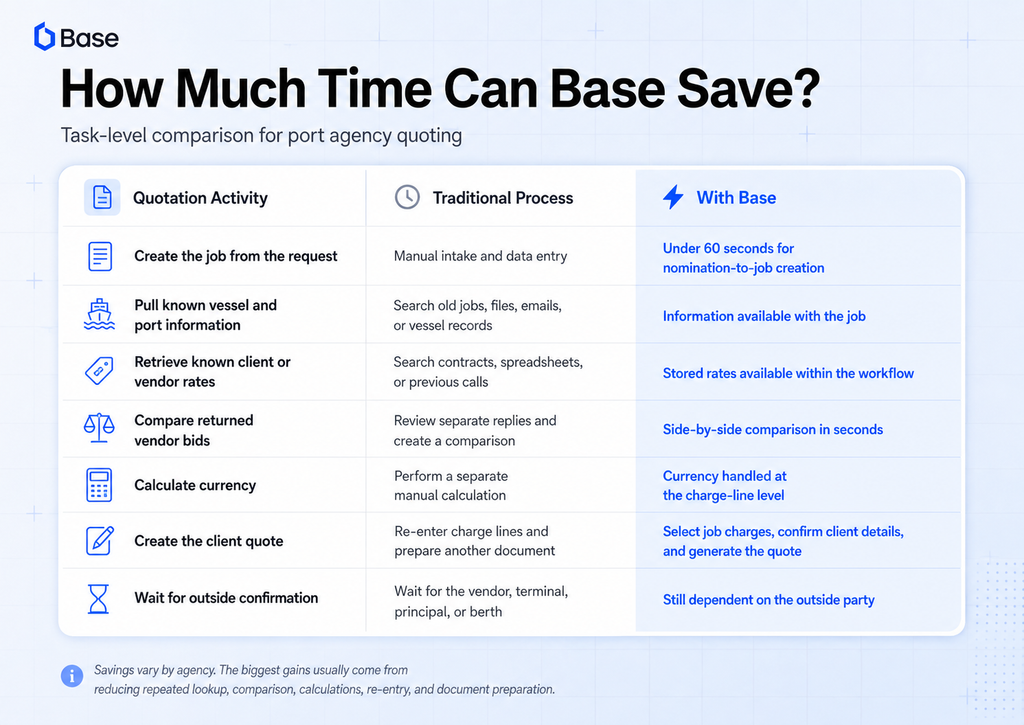
The largest time savings usually sit in the repetitive parts of the workflow.
Faster access to vessel and port information shortens the initial lookup. Stored rates shorten the search for commercial history. Connected vendor responses reduce comparison work. Line-level currency handling removes another separate calculation. Quote generation uses charges that are already in the job.
Those savings accumulate across every quotation an agency prepares.
Conclusion on Port Agency Quotations
A port agency quotation carries more operational work than the finished document reveals.
Before the quote reaches the principal, the agency may have reviewed vessel particulars, checked several rate sources, contacted local vendors, waited for operating information, calculated currency, and adjusted assumptions as the call changed.
Much of that work deserves attention because the quotation becomes an early financial picture of the port call. A bad assumption at this stage can follow the job into the PDA, vendor commitments, and eventual FDA.
That makes the quality of the quotation process important.
Your agency needs current information, clear rate sources, organized vendor responses, and a record that can change as the operation develops. Staff should be able to see where a number came from and carry that information forward when the quote becomes an active job.
This is where Base fits.
Base keeps the request, vessel and port context, contracts, vendor pricing, charge lines, currency, and client documents tied to the same job. The information gathered during quoting remains useful when the agency moves into procurement, PDA preparation, vendor invoicing, FDA preparation, and billing. That continuity saves time during the quote and reduces repeated work later in the call.
A better quotation process gives the agency a cleaner commercial record from the start. The agent can spend more of their attention reviewing the call, checking the assumptions, and making pricing decisions with the information already in front of them.
Key Takeaways
- Port agency quotation time comes from commercial review, administrative work, and outside waiting.
- Vessel information, tariffs, client rates, vendor responses, and operating assumptions all contribute to the workload behind a quote.
- Staff touch time is useful for identifying where internal effort is going during the quotation process.
- Base reduces time at specific stages, including nomination-to-job creation in under 60 seconds and vendor bid comparison in seconds.
- Keeping quotation data tied to the job reduces repeated work later in PDA preparation, procurement, FDA preparation, and billing.
To see PDAs, FDAs, vendor documents and principal approvals handled in one workflow, look at Base’s port agency software.
Frequently Asked Questions
Why Do Port Agency Quotations Take So Long?
A port agency quotation can depend on vessel particulars, port and terminal tariffs, vendor pricing, client agreements, berth assumptions, currency, taxes, service availability, and changing operating conditions. Gathering and checking those inputs can require several systems, records, and outside responses.
Which Parts of Port Agency Quoting Require the Most Human Review?
Rate applicability, unusual port conditions, commercial exceptions, vendor selection, changing operating assumptions, and final approval often require experienced agency input. These are the parts of the process where local knowledge and commercial judgment carry the most value.
How Much Time Can Port Agency Software Save?
The amount depends on the agency’s current process. We can turn a nomination email into a structured Base job in under 60 seconds and allow returned vendor bids to be compared in seconds. Existing vessel information, stored rates, line-level currency handling, and quotation generation from existing job charges can reduce additional staff time.
How Do You Create a Quote in Base?
Once the relevant charges are in the job, the agent opens Quotes and Invoices, creates a new quote, selects the applicable job charges, confirms the client information, and generates the quotation.
How Does Base Help With Port Agency Quotations?
We keep the request, vessel, port, contracts, vendor activity, charges, documents, and later financial records connected to the same job. Information gathered during quotation preparation can continue into procurement, PDA preparation, cost tracking, FDA preparation, and billing.


