


Towage charges can be one of the harder costs to estimate when preparing a port call PDA. You may know how many tugs the vessel is expected to need and have the published tariff in front of you, but the final cost can still change once the vessel arrives.
What is towage?
Towage is the use of tugboats to assist a vessel with movement or maneuvering. Harbor towage covers operations such as berthing, unberthing, and shifting within a port. Ocean towage involves longer-distance towing. Pilotage is a separate service involving a licensed pilot who guides the vessel’s navigation.
For port agents, the challenge is calculating a reasonable estimate before the service happens and accounting for any differences when the final invoice arrives.
We’ll look at how harbor towage is priced, walk through an example using a published U.S. tug tariff, and explain what agents should check before passing the final charges on to the principal.
What Do Towage Charges Cover on a Port Call?
Most commercial vessels need assistance when maneuvering in confined harbor waters, particularly when approaching or leaving a berth.
A large bulk carrier may have plenty of maneuvering capability in open water, but bringing it alongside a terminal requires much more precise control. There may be limited room to turn, strong currents, nearby vessels, or restrictions on how the ship can approach the berth.
Tugs provide additional maneuvering force during these operations.
On a typical port call, towage charges may cover:
- Berthing: Tug assistance when the vessel approaches and moves alongside the berth.
- Unberthing: Tug assistance when the vessel leaves the berth and enters the navigational channel.
- Shifting: Moving the vessel between berths or repositioning it within the port.
- Standby: Keeping tugs available while waiting for the vessel or an operation to proceed.
- Additional assistance: Extra tug services required because of weather, vessel handling conditions, or operational changes.
Towage is usually a separate item on the disbursement account, alongside other port charges such as pilotage, mooring, and berth dues.
Agents often estimate pilotage charges and towage together because both services are closely tied to the vessel’s arrival and departure movements.
However, their pricing structures differ, and each needs to be calculated using the applicable rates.
How Are Harbor Towage Charges Calculated?

There is no single towage rate that applies to every vessel or port.
Tug operators may charge a fixed amount per tug movement, an hourly rate, or a combination of the two. Some ports have published tariff schedules, while others rely on negotiated rates with tug operators.
The cost generally comes down to three things: how many tugs are required, which rate applies, and how long the service takes.
How Many Tugs Does the Vessel Need?
The number of tugs required depends on the vessel and the conditions at the port.
A Panamax bulk carrier arriving at one terminal might require two tugs for berthing. At another berth, the pilot may request additional assistance because of restricted maneuvering space, wind, or current.
Several factors influence that decision:
- The vessel’s length, beam, draft, and maneuverability.
- The berth layout and available turning space.
- Local weather, tidal, and current conditions.
- Port regulations and terminal requirements.
- The available tugs and their bollard pull, which measures their pulling capability.
The pilot or harbor master will generally play an important role in determining the required tug assistance, subject to local rules.
For the agent preparing the PDA, this means the estimated tug count should be confirmed with the relevant parties. Assuming that a vessel will need the same tug arrangement as its previous call can lead to an inaccurate estimate.
Per-Tug Rates, Hourly Charges, and Minimums
Many harbor towage tariffs specify a charge for each tug involved in a movement.
For example, an operator might publish a fixed rate for one tug assisting a vessel into a particular berth. If two tugs are required, that service rate is applied twice.
Arrival and departure are normally treated as separate services.
Some tariffs also include a minimum period within the standard rate. A tug operator might allow up to two hours for a docking movement, with additional time billed at an hourly rate.
Other operators may calculate the entire service according to the hours worked, subject to a minimum charge.
This is why agents need to read the terms that accompany the rate. The amount listed for tug assistance may cover a specific movement, period, or set of operating conditions.
Published Tariffs and Contract Rates
The published tariff provides a starting point, but agents also need to check whether a negotiated contract applies.
A principal may have agreed rates with a tug operator, or the agency may have vendor pricing arrangements that differ from the published schedule.
The agent should establish which rate governs the service before preparing the estimate.
It’s also worth checking the effective date and geographic area covered by the tariff. Rates can differ between terminals within the same port, and an older tariff may no longer apply.
What Additional Charges Can Increase the Towage Bill?

The standard tug assistance rate may account for most of the cost, but several additional charges can affect the final amount.
These are particularly important when estimating a PDA because some depend on conditions that won’t be known until the operation takes place.
| Tug Cost Driver | How It’s Charged | Why the FDA May Differ From the PDA |
|---|---|---|
| Additional service time | Hourly rate after the included period | Berthing or departure takes longer |
| Standby | Hourly charges after a waiting allowance | Tug arrives before the vessel is ready |
| Shifting | Separate service rate or multiplier | Vessel makes an additional movement |
| Cancellation | Percentage of the scheduled service rate | Tug order is canceled after dispatch |
| Holiday service | Additional percentage surcharge | Movement takes place on a designated holiday |
| Higher-powered tug | Surcharge for a specified tug class | Pilot requests a more powerful tug |
| Fuel surcharge | Percentage or fixed charge | Applicable surcharge changes or was omitted from the estimate |
One of the most common reasons for additional towage charges is a delay in the vessel’s movement.
A tug might arrive at the agreed time, only for the vessel to remain alongside because cargo operations are still being completed. Depending on the operator’s terms, standby charges may begin after a specified waiting period.
The same applies when a maneuver takes longer than the standard service allowance.
Cancellation can also create costs. Some operators charge a percentage of the scheduled service once the tugs have been dispatched, even if the movement never takes place.
These charges vary by operator and tariff, so it’s important to know which terms apply before preparing the estimate.
How to Estimate Towage Charges on a PDA
When preparing a proforma disbursement account (PDA), the agent needs to estimate the tug services required for the vessel’s planned movements.
The estimate should be based on the best available operational information and the applicable tariff or contracted rates.
Start by confirming the expected movements. Does the vessel need tug assistance for arrival and departure? Is it expected to shift between berths during cargo operations? Has the pilot confirmed the likely number of tugs?
Once those details are established, the agent can calculate the standard service charges and add any known surcharges.
Let’s look at what that calculation involves using a real published tariff.
Example: Calculating Towage for a Panamax Bulk Carrier
Suppose a Panamax bulk carrier is scheduled to call at Seattle Area I.
For this example, we’ll assume the vessel requires two tugs for berthing and two for unberthing, with both movements expected to finish within the standard two-hour service allowance.
We’ll use rates from the Crowley Pacific Northwest Schedule of Tugboat Rates and Terms, identified in the supplied source material as effective May 1, 2026, which lists a docking and undocking rate of $7,381 per tug, per service for vessels operating under their own power in Seattle Area I.
The tug count is illustrative, but the rates come from the published tariff.
Here’s how those charges would appear on the PDA:
| Towage Charge | Calculation | Estimated Cost |
|---|---|---|
| Berthing | 2 tugs × $7,381 | $14,762.00 |
| Unberthing | 2 tugs × $7,381 | $14,762.00 |
| Base towage charges | 4 tug-services | $29,524.00 |
| Fuel surcharge | 20% of base charges | $5,904.80 |
| Fixed surcharges | 4 × $325 | $1,300.00 |
| Total estimated towage | $36,728.80 |
The fixed surcharges in this example include security, environmental compliance, renewable energy, and tug’s line charges. The renewable-energy amount uses the $100 assumption from the research brief because the supplied tariff line contains conflicting figures. Actual rates and surcharge treatment should be confirmed with the operator.
The base tug assistance charge comes to $29,524. Adding the assumed minimum fuel surcharge and fixed per-service charges brings the PDA estimate to approximately $36,729.
This example shows why it’s important to read the full tariff rather than using the headline tug assistance rate alone.
Even when the number of tugs is known, the estimate needs to account for the charges that apply to each movement. Missing a fuel surcharge or applying a service rate only once when two tugs are required can create a substantial difference before the vessel even arrives.
Why Do Towage Charges on the FDA Differ From the PDA?
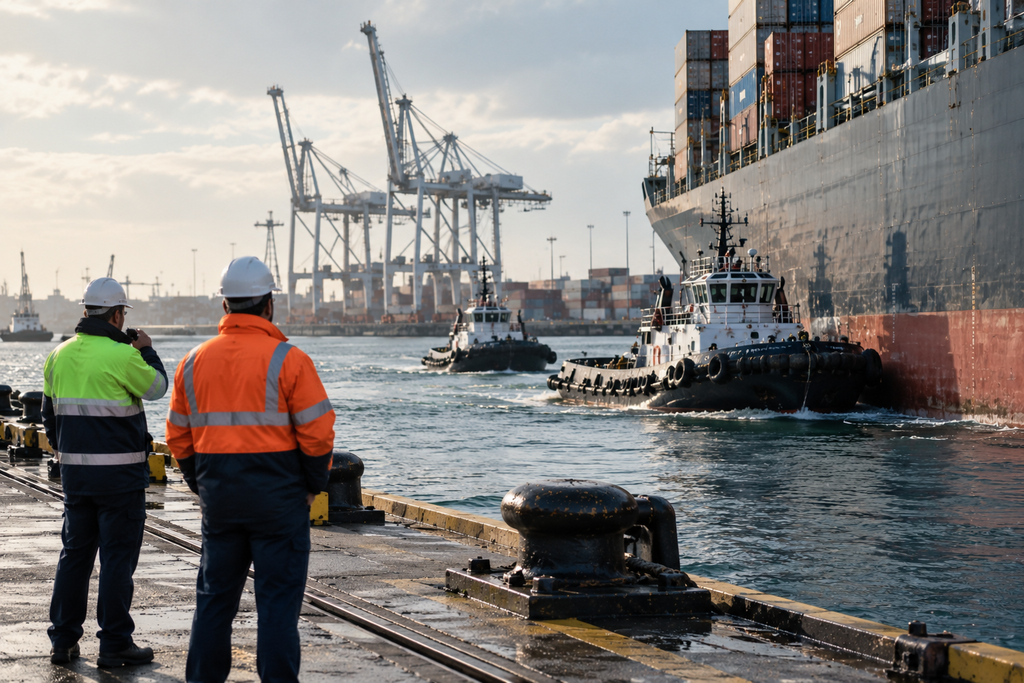
Let’s continue with the Panamax example.
The vessel arrives and berths within the two-hour allowance. That part of the operation goes as expected. When the vessel departs, however, both tugs remain engaged for two and a half hours.
Under the published schedule, time beyond the initial two hours is charged at the applicable hourly rate in half-hour increments.
For South Sound, which includes Seattle, the published hourly rate is $5,075 per tug. That means the additional half-hour of departure assistance creates the following charge:
2 tugs × 0.5 hours × $5,075 = $5,075
Here’s how that changes the disbursement account:
| Amount | |
|---|---|
| Original PDA estimate | $36,728.80 |
| Additional tug service time | +$5,075.00 |
| Illustrative FDA total | $41,803.80 |
| Difference | +$5,075.00 |
This comparison assumes no additional surcharge is applied to the overtime amount. The actual invoice may be higher if the operator applies fuel or other applicable surcharges to the additional service time.
In this case, the difference has a clear operational explanation: the unberthing movement exceeded the standard service period.
Other port calls may involve a more complicated reconciliation.
A vessel might be delayed after the tugs arrive, creating standby charges. A berth change could require an additional movement. A scheduled departure might be canceled after the operator has already dispatched the tugs.
Each situation can affect the amount eventually recorded on the final disbursement account (FDA).
The agent needs to establish what changed during the call and whether the additional charges are supported by the applicable tariff and service records.
How Port Agents Should Check Towage Invoices
Once the tug operator submits its invoice, the agent needs to reconcile it against the services performed and the rates that were agreed upon.
This is where having the original estimate, service records, and applicable rate card available becomes particularly useful.
A practical invoice review should cover the following:
- Confirm the services performed. Check how many tugs attended, which movements they assisted, and whether any additional services were requested.
- Verify the rates. Compare the invoice against the relevant published tariff or contracted vendor rate.
- Check the service times. Review the recorded start and completion times, particularly where overtime or standby charges appear.
- Review surcharges. Confirm fuel, holiday, cancellation, shifting, and other applicable charges.
- Investigate discrepancies. Ask the tug operator for clarification when an invoice includes unsupported charges or amounts above the agreed rate.
- Reconcile and rebill. Record the validated charges, retain the supporting documents, and include the appropriate amounts in the FDA sent to the principal.
Even relatively small differences deserve attention.
An incorrect surcharge applied across several tug movements can become a meaningful expense. The same applies when a vendor bills for more time than the service records support.
A good vendor management process gives agents a way to check those charges against the correct rate card before approving payment.
For agencies handling multiple port calls, consistent invoice checks also make it easier to identify recurring discrepancies with particular vendors or services.
How Base Helps Agents Manage Towage Charges
For port agents preparing PDAs regularly, keeping tug tariffs and vendor agreements up to date can take considerable administrative work.
Rates may differ by port, terminal, tug operator, or principal. Those differences have to be accounted for when preparing the estimate and checking the eventual invoice.
At Base, we’ve built rate management into the port cost workflow so agents can work from stored tariff and contract information.
Our port cost management software maintains mapped published port tariffs, including tug assistance rates, pilotage schedules, berth dues, and other port charges.
For example, a Base product demonstration shows a tug assistance line priced at $2,625 per unit. That’s an illustrative rate within the application, showing how tug charges can be included when preparing a PDA.
Base also allows teams to store contracted rates by vendor and principal, accounting for agreements that may differ from published tariffs. When the tug operator’s invoice arrives, Base can compare the charges against the stored vendor rate card and flag amounts above the agreed rate for review.
That is particularly useful for towage because the final bill can include several separate charges relating to the same vessel movement. The agent can review the differences, confirm the supporting information, and work from the approved figures when completing the FDA.
Keep Your Towage Estimates Tied to the Actual Port Call

Towage is one of those port call expenses where even a well-prepared estimate can change once the vessel is underway. An additional half-hour of tug assistance, an unexpected berth shift, or a delay in departure can all affect the final amount.
That’s why the work doesn’t end when the PDA is submitted. Agents need to know which rates apply, confirm the services performed, and account for any additional charges when preparing the FDA. Having that information readily available also makes it easier to explain cost differences to principals and resolve questions about vendor invoices.
At Base, we help port agents manage both sides of that process. With published port tariffs, contracted vendor rates, and invoice checks in one place, your team can prepare estimates using the appropriate rates and review actual charges against the agreements behind them.
If your team is spending too much time checking tariffs, reconciling tug invoices, or explaining PDA-to-FDA differences, see how Base’s port cost management software can help.
Key Takeaways
- Towage charges depend on the services required. Tug count, vessel characteristics, berth conditions, and service duration all influence the cost.
- Published tariffs and contract rates provide the basis for estimating tug costs. Agents should confirm which rates apply before preparing the PDA.
- Additional charges can significantly affect the final amount. Overtime, standby, shifting, cancellation, fuel, and holiday surcharges should be reviewed carefully.
- The FDA needs to reflect the services actually performed. Differences from the PDA should be supported by operational records and the applicable tariff.
- Rate-card checks help agents identify billing discrepancies. Comparing tug invoices against agreed rates helps prevent unsupported charges from being passed on to principals.
Frequently Asked Questions
What is the difference between towage and pilotage?
Towage involves tugboats assisting a vessel with maneuvering, while pilotage involves a licensed marine pilot guiding the vessel’s navigation through local waters.
The services are commonly used together during berthing and departure, but they are billed separately. Tug charges generally depend on the assistance provided, while pilotage charges follow the applicable pilotage tariff.
How many tugs does a vessel need?
The number of tugs depends on the vessel’s size, maneuverability, berth arrangement, weather, currents, and local port requirements.
A large vessel may need two or more tugs for a particular movement, but there is no universal tug count based on vessel size alone. The pilot or harbor master can help confirm the required assistance.
Who pays towage charges?
Towage charges are generally included in the port call expenses arranged by the ship’s agent and charged to the responsible principal.
The ultimate responsibility for those costs depends on the commercial arrangements between the vessel owner, charterer, operator, and other parties. Charter-party terms and agency agreements may determine which party bears the expense.
Why are towage charges higher than the estimate?
Towage charges may exceed the PDA estimate when the vessel requires additional tugs, the service takes longer than expected, or standby and other surcharges apply.
A difference can also result from using an outdated tariff or an incorrect rate. Agents should compare the final invoice with the applicable rate card and service records before approving the charges.


