


When a ship agency starts looking for new software, it is usually because the work around each port call is getting harder to keep together. Jobs are spread across inboxes and spreadsheets, vendor quotes and POs are difficult to track, and finance is waiting on cleaner cost data before a call can be closed out.
That can push an agency toward maritime ERP systems.
Most maritime ERPs are built for shipowners, operators, and managers. A ship agency usually needs software centered on port calls, vendors, job costs, PDA and FDA, principal billing, and the handoff into accounting.
In this blog, we’ll look at what a maritime ERP is built to handle, where port agency software fits, how each system connects to accounting, and five questions that can help you decide what your agency actually needs.
What Is a Maritime ERP Built to Manage?
A maritime ERP is usually built to manage a wider maritime business, especially the functions associated with owning, operating, or managing vessels.
Depending on the system, that can include:
- Vessel maintenance
- Crewing
- Procurement
- Voyage management
- Chartering
- Payroll
- Fleet financials
- Corporate accounting
Those functions fit companies responsible for the vessel itself and the business around it.
A ship agency has a narrower operating scope. Its work starts with a nomination or service request and follows the port call through vendor coordination, purchasing, costs, PDA and FDA, principal billing, and closeout.
That is why an agency can end up paying for ERP functionality it does not actually need while still lacking the workflows its agents use every day.
For a broader breakdown of maritime software categories, see our guide to maritime software companies.
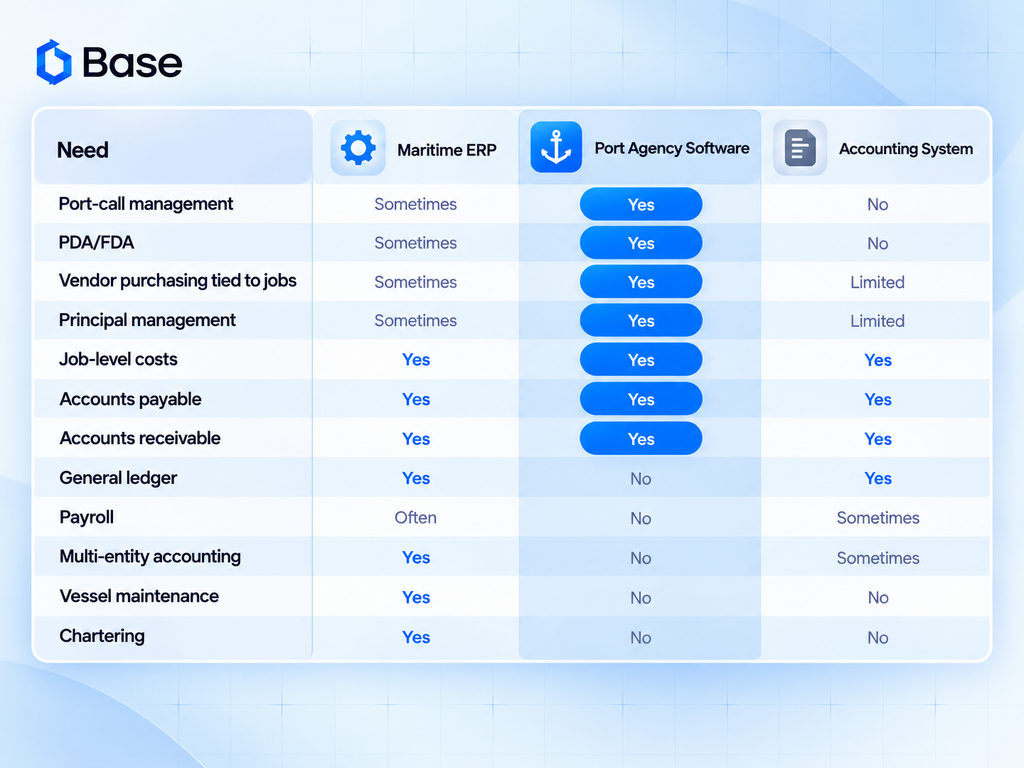
Maritime ERP vs Port Agency Software vs Accounting Software
A maritime ERP manages broad company or vessel-management functions. Port agency software manages the work around the port call. Accounting software manages the company books.
The overlap usually happens around purchasing, AP, AR, and job costs.
A launch boat invoice shows why the overlap matters.
Finance needs the amount, vendor, due date, and accounting treatment. The agency also needs to know which vessel call created the charge, which service it covered, which PO it belongs to, whether it was included in the PDA, and how it should appear on the FDA.
Port agency software keeps that operational context with the job. The accounting system takes care of the financial record once the transaction reaches the books.
The same pattern applies to tug charges, pilotage, crew transport, husbandry costs, and other expenses tied to a vessel call.
The Agency Stack Test: Do You Actually Need an ERP?
Most agencies can answer this by identifying where their biggest software problem sits.
1. Is the Main Problem Inside the Port Call?
If the biggest issues involve jobs, vendor quotes, POs, PDA/FDA, supporting documents, or job costs, the agency likely needs port agency software.
Common signs include:
- Nominations become spreadsheets
- Vendor quotes live in separate email threads
- POs are hard to track
- Actual costs take too long to reach the job
- PDA and FDA require information from several places
- Finance has to chase operations for cost details
- Vendor invoices arrive without a clear link to the job or service
These are port-call workflow problems.
The system handling them needs to understand the vessel, port, principal, vendors, estimated charges, actual charges, documents, and billing history tied to the call.
See our guide to maritime shipping software for a wider look at this category.
2. Is the Main Problem in Corporate Finance?
If the biggest issues involve group accounting, payroll, consolidation, or company-wide finance, an ERP or larger financial system may be the better fit.
That can include:
- Multi-entity reporting
- Intercompany accounting
- Payroll
- Group budgeting
- Fixed assets
- Company-wide purchasing
- Advanced general-ledger controls
These requirements sit above the individual port call and affect the company as a whole.
3. Does the Company Manage Vessels as Well as Port Calls?
If the company also handles vessel maintenance, crewing, chartering, technical management, or commercial voyage activity, a maritime ERP may be appropriate.
Those responsibilities go beyond agency work and require software built around the vessel as well as the port call.
For a company focused mainly on nominations, vendor coordination, port services, PDA/FDA, and job closeout, port agency software will usually fit the work more closely.
We cover a similar category question in Voyage Management System vs Port Call Software.
A simple way to read the test is:
- Port-call problems → Port agency software
- Corporate finance problems → Accounting system or ERP
- Ship-management problems → Maritime ERP
How Does Port Agency Software Connect to Accounting?

Port agency software should carry the financial details of the port call into the accounting system without forcing finance to rebuild the job.
A typical flow looks like this:
Port call → Job → Vendor costs → PDA/FDA → Accounting
During the call, the agency system keeps costs tied to the correct vessel, vendor, service, quote, PO, and supporting documents.
When the final vendor invoice arrives, the amount can be matched to the job and carried through to the FDA. The accounting system then receives the financial information it needs for the company books.
Base is built to support that flow.
Agencies can manage jobs, purchasing, vendor costs, PDA/FDA, accounts payable, accounts receivable, and other financial activity tied to the call inside Base.
Base also supports:
- QuickBooks Online
- Xero
- REST API v1
- MCP server
- Organization API keys
- ERP system integration
QuickBooks Online, Xero, REST API v1, the MCP server, and organization API keys begin at the Efficiency tier.
You can read more about Base’s QuickBooks integration and the Xero integration.
For an agency that already has an accounting system it wants to keep, this allows the port-call work to stay in the agency system while the company books remain in the financial system.
When Does a Ship Agency Need a Full ERP?
A ship agency is more likely to need a full ERP when its software requirements extend well beyond port-call operations.
That usually happens in a few situations.
A multi-entity group may need consolidated reporting, intercompany accounting, centralized controls, and financial reporting across several legal entities.
An agency may also need an ERP if payroll, fixed assets, corporate purchasing, budgeting, and other company-wide finance functions need to sit in the same system.
The case becomes stronger when the business manages vessels directly. Planned maintenance, crewing, technical management, chartering, and commercial voyage activity all require capabilities outside the normal agency workflow.
Some larger companies will therefore use both systems.
The ERP can handle the company-wide or vessel-management work, while port agency software handles the jobs, vendors, costs, documentation, PDA/FDA, and financial activity tied to each port call.
What Does a Ship Agency Actually Need?

The right software depends on where the work actually sits.
If the biggest problems are around port calls, vendor coordination, purchasing, PDA and FDA, job costs, and principal billing, port agency software is usually the better fit. If the business also needs multi-entity accounting, payroll, vessel management, crewing, or wider corporate finance, an ERP may have a role too.
For many agencies, that means using both layers for different parts of the business.
Base is built for the agency side of that stack. It gives teams one place to manage jobs, vendors, purchasing, PDA and FDA, job-level financial activity, and the documents tied to each call, then connects that work into the accounting system the business already uses.
If your agency is comparing maritime ERP systems because port-call operations have become harder to manage, see how Base handles port agency operations.
Frequently Asked Questions
What is a maritime ERP?
A maritime ERP is a business management system used by maritime companies to handle functions such as accounting, procurement, vessel management, maintenance, crewing, voyage management, chartering, and payroll.
Do ship agencies need an ERP?
Some do, especially agencies with multi-entity accounting, payroll, vessel-management responsibilities, or complex corporate finance needs. Agencies mainly looking to improve port-call operations may be better served by port agency software connected to their accounting system.
What is the difference between maritime ERP and port agency software?
A maritime ERP usually manages wider company or vessel functions. Port agency software manages the work surrounding port calls, including jobs, vendors, purchasing, costs, PDA/FDA, documentation, and principal billing.
Can port agency software integrate with an ERP?
Yes. Port agency software can hold the operational and job-level financial record while passing financial data into the company’s accounting or ERP system. Base supports ERP system integration along with QuickBooks Online, Xero, REST API v1, MCP server, and organization API keys.


