


An offshore EPC project can create a lot of port cost activity before finance ever sees a final disbursement account.
An installation vessel may work from one port while PSVs cycle through a supply base. Crew changes may happen somewhere else. Mobilization and demobilization can involve different local agents again.
Each agent eventually sends its own DA, often in a different format and currency.
A Norwegian agent might submit an FDA in NOK for the installation vessel. A UK agent may bill a supply-vessel call in GBP. Another could send crew-change and launch costs in EUR.
On the principal side, all of those costs have to end up in one project accounting process.
That means matching the DA to the right purchase order, confirming the service entry sheet, assigning the correct WBS or cost code, checking the currency treatment, reviewing the supporting evidence, and getting the record ready to post in the ERP.
For a principal-side controller, that is where the reconciliation work sits.
What Is Multi-Agent DA Reconciliation?

In this context, multi-agent DA reconciliation is the principal-side process of validating and posting disbursement accounts received from multiple port agents by matching each charge to the correct purchase order, service entry sheet, WBS or cost code, currency treatment, supporting evidence, and ERP record.
The port agent is sending the financial record of what happened during the call.
The principal takes that record and fits it into the commercial and accounting structure of the offshore project.
A DA may show tug assistance, pilotage, crew transport, storage, crane hire, agency fees, and other local services.
Finance has to answer a different set of questions around those charges.
Was the spend authorized? Has the service been accepted? Which work package should carry it? Has any of it already been accrued? Which exchange rate applies? Does the backup support the charge? Is the record ready to post?
Those questions make up the actual reconciliation process.
Walking the Reconciliation: The DA-to-ERP Control Chain
Once the DA lands with finance, it follows a fairly clear path before the cost reaches the project books.
For this article, we will call that path the DA-to-ERP Control Chain:
DA → PO → SES → WBS → ERP Posting
1. DA: What Is the Agent Billing?
The review starts with the account itself.
Finance needs to understand what the agent is charging for, which vessel and call the costs relate to, what supporting invoices or receipts are included, and which currency is being used.
The DA may also carry the agent’s own job number, vessel reference, call reference, or client reference.
Those details become important as finance tries to connect the account to the principal’s internal records.
2. PO: Was the Spend Authorized?
The DA then needs to match the right purchase order.
That gets harder when the agent references only the vessel or its own job number, several vessel calls sit under one PO, or additional work during the call pushes the FDA above the remaining commitment.
A construction vessel may need an extra tug movement. A weather delay may extend launch or transport services. Additional husbandry work may be ordered while the vessel is alongside.
Those charges still have to tie back to an authorized commercial record before they can continue through finance.
3. SES: Was the Service Received?
For services processed through a service entry sheet, finance also needs confirmation that the work was performed and accepted.
A tug may have attended exactly as ordered. The invoice can still sit in review if the related SES is missing or waiting for approval.
This timing mismatch is common on active offshore projects. Offshore vessel operations keeps moving while procurement and finance work through the records created by earlier vessel activity.
4. WBS: Where Does the Cost Belong?
Once the commercial references are clear, the cost has to land in the right part of the project.
A tug charge may belong to the marine spread. Crew transport could sit under personnel logistics. Crane hire might belong to an installation package. Temporary storage may need to hit project cargo.
One DA can easily contain charges that belong to several WBS elements or cost codes.
That makes line-item detail especially important. A broad description such as “additional attendance” may tell the agent what happened, while giving the controller very little information about where the cost should go.
5. ERP Posting: Is the Record Ready?
The final step is getting the transaction ready for the ERP.
The record may need the correct vendor, PO, SES, WBS, currency, tax treatment, approvals, and supporting documents before posting.
At this point, the controller should be able to trace the cost from the agent’s DA through the project records that support it.
The DA-to-ERP Control Chain gives that reconciliation a clear sequence. It also makes the common break points easier to identify.
Where the DA-to-ERP Control Chain Breaks
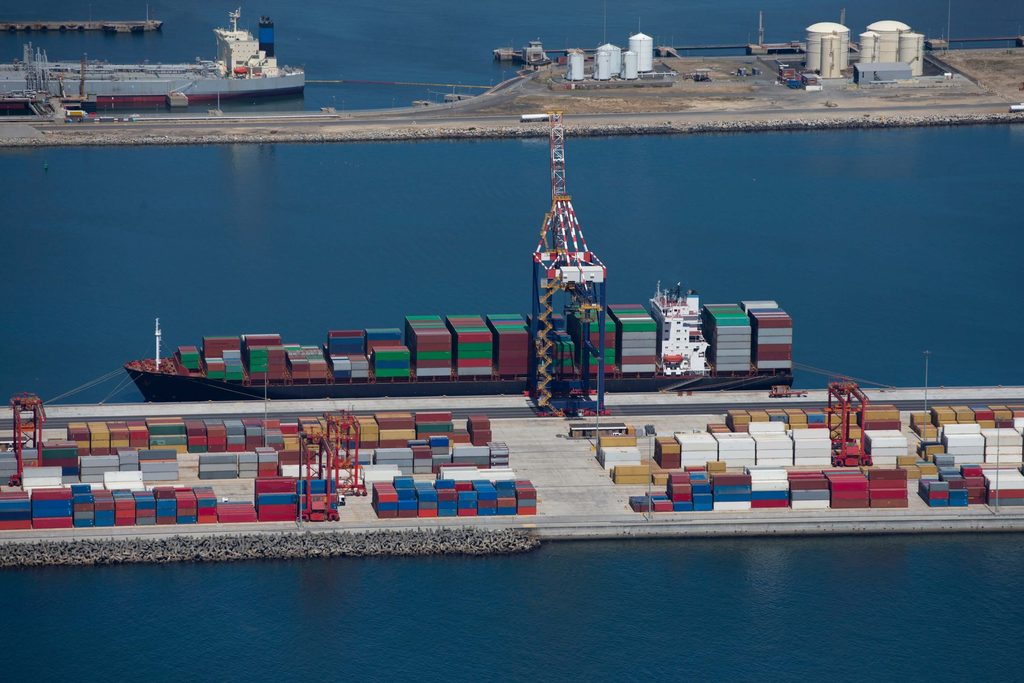
Reconciliation delays commonly come from missing references, incomplete approvals, coding questions, currency differences, and supporting documents that do not line up cleanly with the DA.
The table below shows the break points controllers are likely to see across offshore EPC projects.
| Break Point | Typical Cause | Control |
|---|---|---|
| DA → PO | Missing, incorrect, or outdated PO reference | Validate the PO when the DA is received |
| DA → PO | FDA exceeds remaining commitment | Compare the final account against open PO value |
| PO → SES | Service completed but SES is missing or unapproved | Track SES status alongside the DA |
| PO → SES | Service wording differs between records | Maintain consistent service mapping |
| DA → WBS | DA line is too broad to code | Require enough line detail for allocation |
| DA → WBS | One charge spans several work packages | Support split allocation |
| Currency | FX timing creates apparent variance | Separate FX movement from service-cost variance |
| Evidence | Backup cannot be tied to the DA line | Keep supporting evidence with the relevant charge |
| Period Close | FDA arrives after the accounting period closes | Accrue the expected cost and reconcile the actual later |
| ERP Posting | Required coding, approval, or support is missing | Check posting requirements before ERP handoff |
The table also shows why the workload grows quickly across offshore EPC projects. The controller is reconciling several relationships at once, and each port agent may present those relationships differently.
Why Multiple Port Agents Make the Problem Harder
Different agents rarely submit DAs in exactly the same way.
One may separate pilotage, towage, launch services, transport, and agency fees line by line. Another may group several services together. Local descriptions may have no obvious equivalent in the principal’s WBS structure.
Take a vessel call with tug assistance, crew transport, crane hire, temporary storage, port dues, and agency attendance.
The agent may treat those as six services attached to one vessel call.
Finance may need to divide the same costs across marine logistics, installation, personnel support, project cargo, and general port costs.
Bundled DA lines make that allocation harder because the controller has to work back through the supporting information to understand the split.
Now add several ports and agents to the project.
Each account can arrive on a different schedule, in a different currency, with different references and a different level of detail. The principal still has one project accounting structure and one set of rules for PO, SES, WBS, approval, and ERP posting.
That creates a many-to-one problem:
Many agent records → one project accounting structure
At project scale, finance needs to know where every DA stands, which records are ready to move forward, and which ones need more information.
Why FX and Period Close Add Another Layer

Offshore projects often have several currencies in play at the same time.
The PO may be in USD, the FDA in EUR, and the supporting tug or pilotage invoice in NOK. Project reporting may come back to USD.
The exchange rate used can depend on the contract, accounting policy, and the date the transaction is recognized.
Suppose a PDA estimates a service at €100,000 and the FDA also comes in at €100,000.
The service cost matched the estimate exactly. A movement in EUR/USD before posting can still create a difference in the project’s USD reporting. Finance therefore needs to separate two types of variance:
Operational variance: the underlying service cost changed.
FX variance: the reporting value changed because of currency movement.
Period close adds another timing issue. A vessel call may finish on March 27, while the agent is still waiting for final port authority, pilotage, or vendor invoices when March closes. Finance books a $90,000 accrual based on the latest available information.
The FDA arrives on April 8 for $97,500.
The controller then has to reconcile the final actual against the amount already recognized and explain the $7,500 difference.
Additional scope may account for part of it. FX may account for another portion. A vendor charge could have come in higher than expected. A line may need a different WBS allocation. Some of the amount may already have been recorded elsewhere.
The result can affect accrual accuracy, WBS actuals, month-end variance, and forecast reporting. The vessel may already be back offshore while finance is still closing the financial record from its last call.
What a Project-Wide Reconciliation View Changes
Once several agents are involved, reviewing individual DAs only tells finance part of the story.
The controller also needs a project-wide record showing where each account sits in the reconciliation process.
That record can connect:
Agent → Vessel Call → DA → PO → SES → WBS → Evidence → ERP Status
From there, finance can see which accounts are waiting on a PO, missing an SES, carrying an unmapped WBS line, lacking backup, tied to an open accrual, or held before posting.
Period-close reporting becomes clearer as well.
Some calls may still carry PDA estimates. Others may have accruals. Some FDAs may be under review, while others have already posted as final actuals.
Seeing those states across the project gives the controller a clearer picture of open port-cost exposure and where follow-up is needed.
How Software Like Base Supports That Shared View
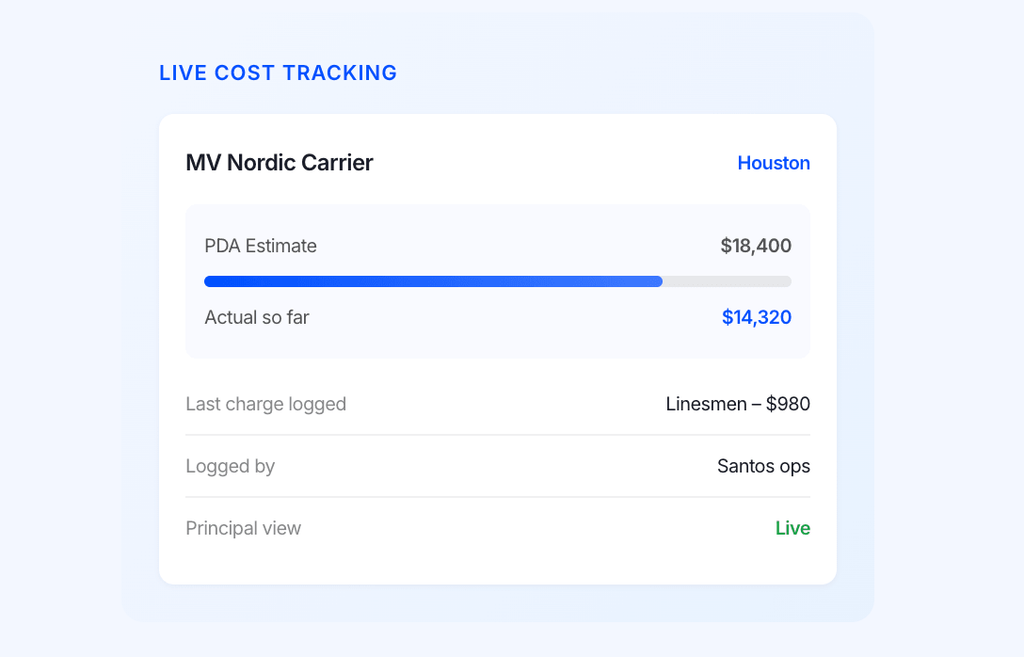
Software like Base can help keep the operational and financial context together as each DA moves from the agent’s submission toward ERP posting.
Instead of treating the FDA as a standalone document, Base can keep it connected to the vessel call, project, agent, supporting evidence, and financial status.
For a principal-side controller, that can help in a few specific ways:
- Keep each DA tied to the vessel call that created it. The controller can see the vessel, port, agent, charges, supporting documents, and related activity in the same job record rather than rebuilding that context from email and spreadsheets.
- Roll multiple vessel calls into one offshore EPC project. Individual calls can remain separate while still feeding a wider project view, which helps finance see open costs across several agents, ports, and vessels.
- Keep supporting evidence close to the charge. Vendor invoices, receipts, approvals, and other backup can stay with the relevant job and financial record, making it easier to review what supports each DA line.
- Track where a cost is still held up. Finance can distinguish between records that are waiting on additional information, under review, approved, or ready to move forward.
- Keep cross-organization questions attached to the work. Base Connect can keep clarification requests, revised documents, and supporting files tied to the relevant job or project, which reduces the amount of context lost across separate email threads.
- Give the principal a project-wide view without losing call-level detail. Finance can look across the offshore EPC project while still tracing an individual cost back to the agent, vessel call, and source documentation behind it.
That kind of connected record is especially useful when several port agents are feeding DAs into the same project. The controller can see the status of the cost and the context behind it without having to reconstruct the same chain every time.
DA Reconciliation Is Part of Offshore EPC Cost Control
Port costs on an offshore EPC project are created across vessels, ports, vendors, and local agents. The principal still has to bring those costs into one project accounting process.
The DA-to-ERP Control Chain gives controllers a practical way to organize that work:
DA → PO → SES → WBS → ERP Posting
Each cost needs a clear connection from the agent’s account through the commercial, project, and accounting records that support it. When those connections stay visible across the project, finance has a much clearer picture of what has posted, what remains open, and where a reconciliation issue needs attention.
If your team is managing disbursement accounts across multiple agents, vessels, and projects, learn more about how Base supports the process with disbursement accounting software.
Key Takeaways
- Offshore EPC principals often receive DAs from multiple port agents across different vessels, ports, currencies, and billing formats.
- Each DA has to move through the same basic control path: DA → PO → SES → WBS → ERP Posting.
- Reconciliation commonly breaks at missing PO references, unapproved SES records, unclear WBS coding, incomplete backup, and FX differences.
- Multi-currency projects need to separate operational variance from FX variance so project reporting reflects what actually changed.
- Late FDAs can affect accruals, WBS actuals, month-end variance, and forecast reporting after the vessel call is already complete.
- A project-wide reconciliation view helps controllers see which DAs are open, under review, missing information, approved, or ready to post.
- Software like Base can keep vessel-call context, financial records, supporting documents, and cross-organization communication connected throughout the reconciliation process.
Frequently Asked Questions
How often should offshore EPC teams review open DAs?
Open DAs should usually be reviewed often enough to support the project’s close cadence, accrual process, and cost reporting. On active marine campaigns, that may mean a standing review of outstanding FDAs, unresolved coding, missing backup, and aged accruals before month-end.
Who should own DA reconciliation on the principal side?
Ownership often sits across finance, project controls, procurement, and marine logistics rather than with one person. Finance may own posting readiness, while procurement controls PO and SES records and project controls owns WBS allocation.
Should one PO cover multiple port calls?
It can, depending on how the principal structures procurement. The tradeoff is that broader POs can make remaining commitment, call-level allocation, and invoice matching harder to read unless the supporting references are disciplined.
How should principals handle shared port costs across several work packages?
Shared costs usually need an agreed allocation method before posting. That could be based on vessel, scope, usage, contractor responsibility, or another project rule. The important part is applying the same method consistently and retaining the basis for the split.
What should principals track for aging DAs?
Useful aging fields include vessel call date, agent, latest PDA, expected FDA date, accrued value, outstanding backup, SES status, coding status, and days open. That gives finance a clearer picture of which accounts need follow-up before close.
When should a controller escalate an unresolved DA?
Escalation usually makes sense when an unresolved item is holding up period close, creating a material accrual uncertainty, exceeding PO authority, lacking enough support for approval, or affecting a significant WBS or forecast position.


