


Offshore wind logistics brings together vessel movements, crew rotations, port services, vendors, weather changes, project schedules, and cost tracking.
For CTV and SOV operators, the challenge is keeping all of those moving parts connected across a high volume of calls and constant schedule changes.
This blog looks at how offshore wind port coordination differs from conventional vessel operations, how construction and O&M create different logistics demands, where spreadsheet-based processes start to break down, and what a stronger coordination model should keep together.
We will also look at how CTV and SOV activity can be tied back to projects, vendors, and financial records so teams have a clearer view of both the operation and the costs behind it.
Why CTV and SOV Port Calls Run Differently
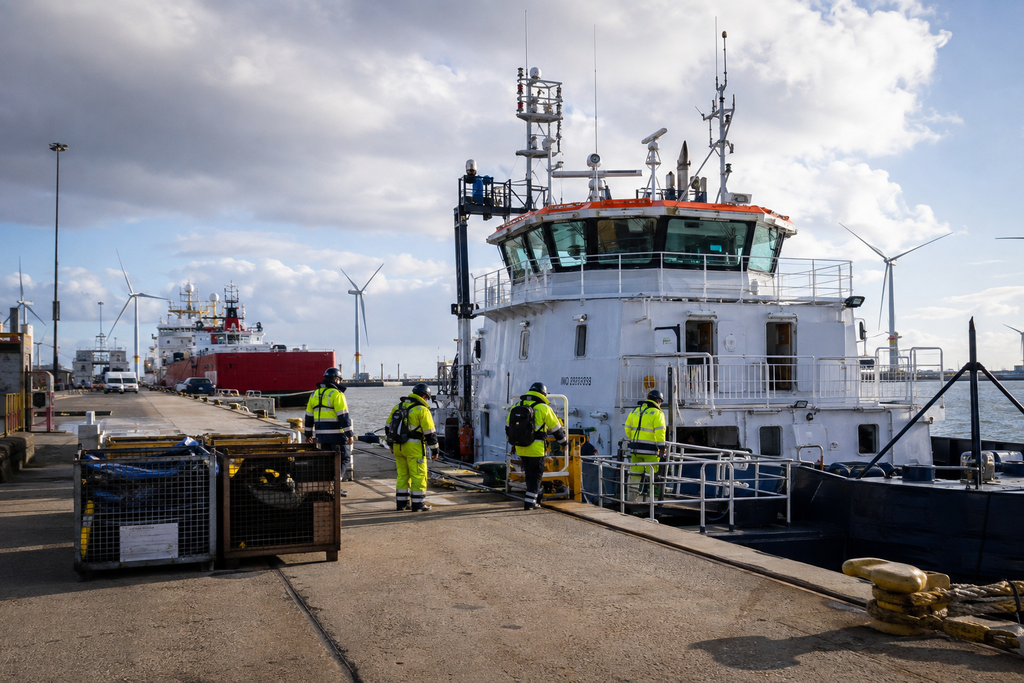
A cargo call often gives the port team one large operation to organize around. Offshore wind work tends to move at a much faster cadence, especially when multiple CTVs are cycling through the same port.
A single CTV may return, rotate technicians, load parts or stores, handle waste or fuel, and head back offshore within a short window. Then the process starts again with the next sailing.
Individually, these movements may seem manageable. The pressure builds through repetition. One missed transport charge is unlikely to disrupt port call cost management, and one hotel invoice coded to the wrong call may be easy to correct. Across several vessels and months of activity, those small errors can become a much larger accounting problem.
Here’s some of the reasons why CTV and SOV port calls can be so challenging:
The turnaround window leaves little room for loose coordination
CTV port calls often require several activities to come together within a narrow window.
Technicians may be arriving as spares are being delivered to the berth. At the same time, port access, baggage, PPE, fuel, stores, or waste services may all need to be ready for departure.
There is not much room for delay. A late vehicle can hold the crew, while a missing access credential can leave a technician waiting at the gate. If a pallet arrives after the vessel is ready, the team may have to decide whether to hold the sailing or send the vessel offshore without it.
That tight sequencing makes timing one of the defining features of offshore wind port coordination.
Weather can change the entire operating plan
A weather update can affect far more than the vessel schedule.
If a sailing window moves, crew transport may need to be changed. Hotel bookings can shift with it, along with berth use, vendor attendance, equipment delivery, technician hours, and the offshore work plan.
The administrative burden grows when those changes are recorded in different places. A revised departure time may sit in one spreadsheet while transport has already been updated by email and a vendor is still working from yesterday’s instructions.
At that point, the team is managing several versions of the same operation.
Crew rotation often sets the pace
People movement plays a major role in offshore logistics.
Technicians may be working around flights, hotel bookings, certification requirements, port access, offshore assignments, handovers, and working-hour limits. Those arrangements have to line up closely with vessel availability, weather windows, and the offshore schedule.
On a busy CTV program, the crew plan can become the organizing point for much of the day.
SOV calls create a different workload. They typically happen less often, while each visit may involve a broader scope of activity. A single port stay can include larger personnel changes, provisions, technical contractors, spares, fuel, waste handling, and equipment.
CTV operations place more pressure on repetition and frequency. SOV calls place more activity inside each individual port stay.
Construction and O&M Put Different Pressure on the Port
The logistics model also changes as a wind farm moves from construction into operation and maintenance.
During construction, the port can be supporting a shifting mix of contractors, vessels, installation activity, temporary facilities, equipment movements, and work packages. The schedule may change with project progress, weather, vessel availability, or the sequence of offshore work.
A single port might be supporting several different scopes at once.
That makes allocation important. A vendor bill cannot simply belong to “the wind farm.” Someone may need to know which vessel used the service, which call created the charge, which contractor requested it, and which project package should carry it.
O&M settles into a more repetitive pattern.
CTV runs become familiar. Technician movements follow recurring rosters. Preventive maintenance generates planned sailings, while corrective work introduces short-notice changes. Local suppliers may become regular parts of the operation.
Familiarity helps, but repetition introduces its own risk. Processes that work 95 percent of the time still leave a lot of cleanup when they are repeated hundreds of times.
A forgotten PO, a charge attached to the wrong sailing, or a crew update sitting in the wrong spreadsheet can stay unnoticed for weeks.
Construction puts pressure on coordination across a changing project. O&M puts pressure on consistency over time.
A Practical Coordination Model for Offshore Wind Calls
For high-frequency CTV and SOV work, it helps to think about each port movement as part of a repeating coordination loop:
Plan → Mobilize → Turn → Replan → Reconcile
The five stages overlap in practice, especially when several vessels are moving at once, but the model gives operations and finance a common way to think about the work.
Plan
Every sailing starts with an expected picture of the call.
Which vessel is moving? Who is travelling? What needs to go offshore? Which suppliers are expected at the port? Where is the vessel berthing? What work package is being supported?
The plan does not have to survive unchanged. Offshore logistics teams know better than to expect that.
It does need to provide a clear reference point so that later changes make sense.
Mobilize
Once the sailing is taking shape, everything around it starts moving too.
A transport provider gets instructions. The hotel roster changes. Spares are released from storage. A supplier receives a delivery time. Port access is arranged. Fuel or waste services are booked.
Each activity produces its own little trail of emails, quotes, confirmations, POs, attachments, and messages.
On a quiet day, keeping track of that material is manageable. During a busy campaign, the number of small records can become larger than the number of vessel movements themselves.
Turn
When the vessel reaches port, planned times become actual times.
Arrival, crew exchange, loading, vendor attendance, service completion, and departure all tell the story of what happened.
Those details also matter later.
If a supplier charges waiting time, someone needs enough context to understand why. If a vehicle had to return twice, there should be a record of the schedule change that caused it. If a call ran longer than planned, the project team may want to know what held it up.
A reliable timeline gives those later questions somewhere to go.
Replan
This is where offshore wind operations spend a lot of their day.
Tomorrow’s sailing moves to the afternoon. The technician roster changes. A part misses its delivery window. The offshore team changes the work priority. The vessel develops a technical issue.
Each revision creates follow-on decisions.
Some bookings are changed. Others are cancelled. A hotel night gets added. A vendor moves to a different time. A charge that looked unnecessary on the original plan becomes completely reasonable once the new circumstances are understood.
That context is worth keeping because the invoice usually arrives long after everyone has moved on to the next call.
Reconcile
Eventually, the operational story becomes a financial one.
A supplier sends an invoice. Finance compares it with the PO. The project team checks the service. Costs are assigned to the right vessel, call, client, project, or work package.
For a single movement, that may be straightforward.
For a CTV operation turning several vessels every day, reconciliation becomes another high-frequency process. The quality of the records created during the call determines how much detective work is left at the end of the month.
Where Offshore Wind Logistics Starts Breaking at Scale
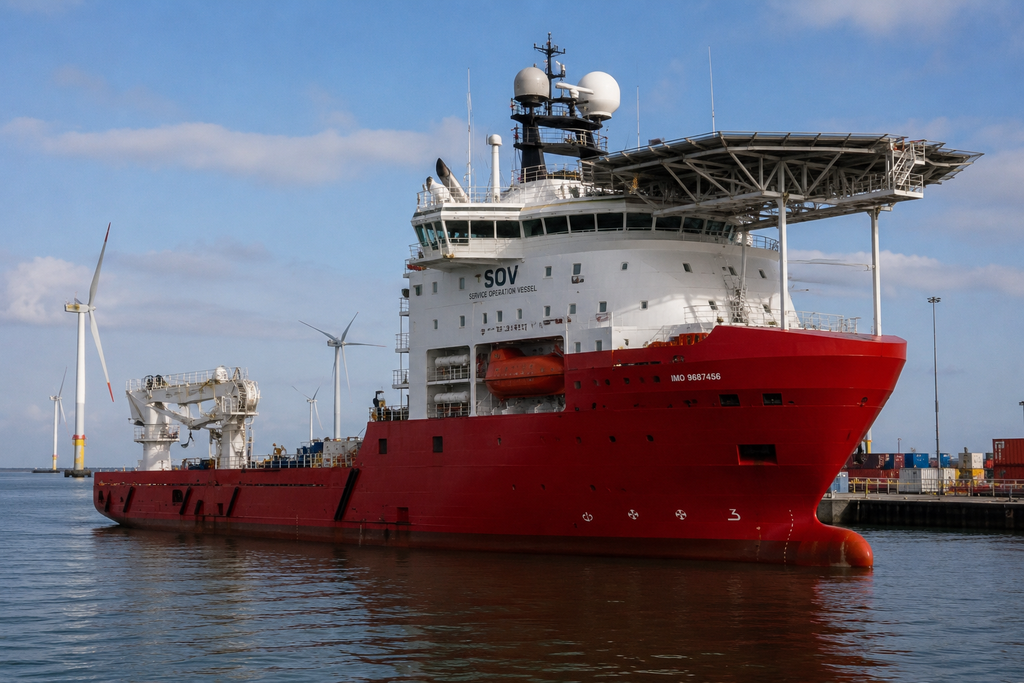
Most offshore wind operators do not struggle because they lack marine knowledge. They know how to run the vessels, manage technicians, and react when the weather moves.
Administrative control tends to weaken first.
The vessel schedule may be well maintained, while the crew plan sits in another file. Transport instructions are sent over email. Vendor commitments sit in message threads. Finance has its own workbook for costs.
For a while, that setup can work because the people involved know what the files mean.
Volume exposes the gaps.
Picture a weather change affecting three CTV sailings the following morning. Someone revises the vessel schedule. Another person adjusts crew transport. Hotels need updated room nights. A supplier receives a later delivery time. One contractor replaces two technicians.
Six hours later, the operation is still perfectly workable, but the information about it is scattered across several places.
That is the point where the administrative record begins drifting away from the operation.
Project context gets lost surprisingly quickly
The crew coordinator probably remembers why a vessel sailed on Tuesday.
Finance may be looking at the related invoices three weeks later.
By then, a generic line such as “crew transport” or “port services” may not tell them enough. They may need to know which vessel movement generated the expense, who requested it, what scope of work was being supported, and why the cost differed from the original expectation.
When the answer lives in someone’s memory, month-end becomes unnecessarily painful.
Lots of small charges are harder than a few big ones
This is one of the more overlooked parts of offshore logistics.
A large marine invoice usually gets attention. A $200 taxi, an extra hotel night, a berth service, a waste collection, or a minor handling charge can pass through with far less scrutiny.
Yet offshore logistics generate these charges repeatedly.
Across a construction campaign or a long-term O&M contract, the cumulative value can become significant. The bigger issue is often attribution. Finance may know who invoiced the company and what service category it belongs to while still lacking the operational detail needed to assign it correctly.
For that reason, a useful cost record usually needs a chain of context:
Vendor → service → vessel → call → project → work package
When one of those links disappears, someone usually has to rebuild it later.
Weather-related costs need their operating story
Say Wednesday morning’s sailing is pushed to Thursday.
The project may now carry another hotel night, a transport cancellation, a revised berth booking, supplier waiting time, or an extra vessel charge.
None of those costs is strange once you know what happened.
They become harder to defend when the invoice arrives without the change history beside it.
That is why good offshore wind cost control starts during the operation. Waiting until the accounting close leaves finance working backwards from the bill.
What an Offshore Wind Logistics System Has to Keep Connected
A vessel schedule is only one piece of the record.
For day-to-day offshore wind coordination, the information around a call usually falls into five connected areas: vessel movement, personnel, suppliers and services, financials, and the wider project.
Take tomorrow morning’s CTV sailing.
The vessel record covers the port, berth, expected movement, actual times, and operating status. The personnel side tells the team which technicians are travelling and what transport, accommodation, documentation, or port access is associated with them.
Around that sit the vendors. One may be fueling the vessel. Another is delivering parts. A transport company is handling the technicians. Each supplier can generate a quote, approval, PO, completion record, invoice, or receipt.
Then there is the money.
The cost needs enough context for someone outside the immediate operations team to understand what was purchased and where it belongs.
Finally, the whole movement has to roll back into the wind farm project.
For construction, that might mean a campaign, contractor scope, or installation package. In O&M, it could be a maintenance program, site contract, or service period.
Once those connections are present, managers can look beyond individual calls and ask better questions. What are we spending on this campaign? Which vessels are generating the most local service costs? Where are weather changes creating repeat expenses? Which invoices are still open?
Those questions are difficult to answer from a collection of standalone spreadsheets.
How Base Fits Offshore Wind Port Coordination
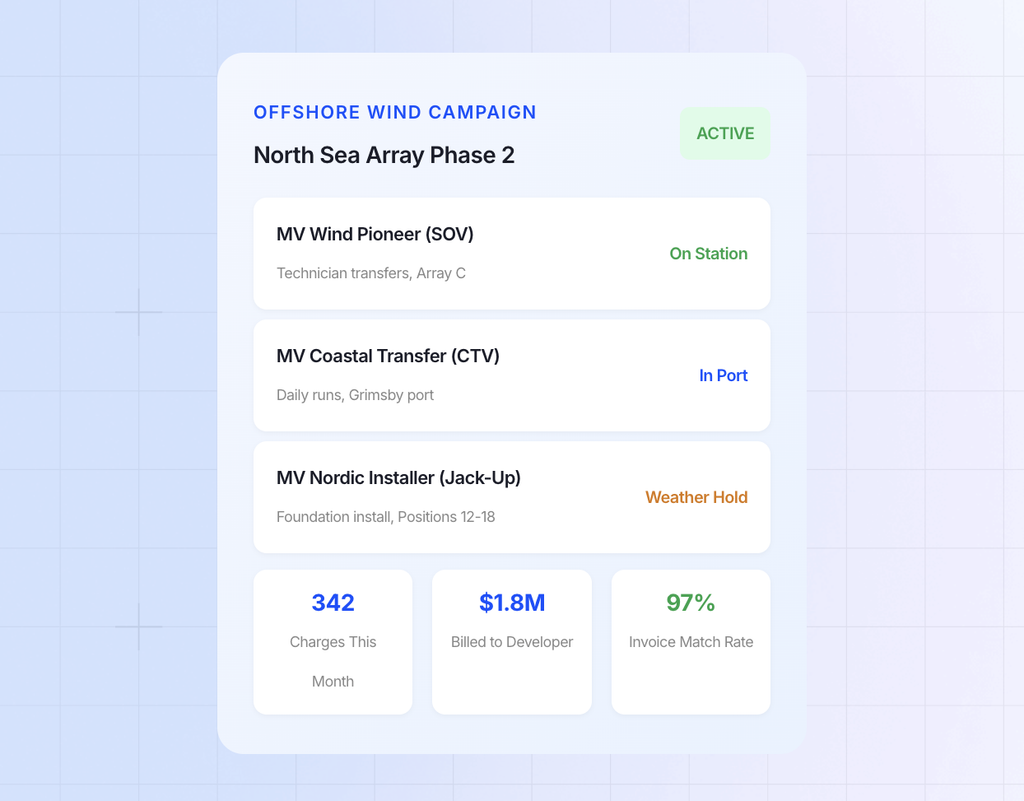
Base is built around a job record that carries both operational and financial activity.
For an offshore wind team, a CTV or SOV call can be managed as a Job containing the vessel, port, dates, suppliers, services, charges, approvals, documents, and related activity.
That gives everyone working on the call a common reference.
A vendor request can remain associated with the Job where the service was needed. The resulting quote and PO stay with the same work. When the invoice arrives later, finance can see the call behind the charge rather than looking at the invoice in isolation.
Projects give the operation another useful layer.
Several CTV movements, SOV calls, supplier jobs, and financial records can sit under the same wind farm campaign or O&M program. Managers can review the larger body of work without having to piece it together from separate vessel files.
This becomes particularly useful during periods of schedule volatility.
If weather changes a sailing and that change produces a new vendor instruction, additional accommodation, or another charge, the activity can stay with the same working record. The explanation remains close to the cost.
For offshore wind teams dealing with hundreds of small movements, that continuity matters.
The value shows up later, when an operations lead can open a call and understand what happened without searching through old emails, or when finance can review a supplier charge without tracking down the person who happened to be on shift that day.
Can You Reconstruct Tomorrow’s Sailing From One Record?
There is a fairly simple way to judge the health of an offshore wind logistics process.
Pick one upcoming CTV movement and try to answer:
- Who is sailing?
- What is going offshore?
- Which suppliers are attending?
- What changed from the original plan?
- Which costs have already been approved?
- Which project or work package does the sailing support?
- What has already been spent?
- What documentation is still outstanding?
Then ask the same questions about a vessel movement from three weeks ago.
Current information is usually easier because the people involved still remember the details. Historical calls show whether the process itself is carrying the knowledge.
If yesterday’s operation can only be understood by finding the right spreadsheet, searching a mailbox, and asking someone what happened, the record is too dependent on individual memory.
Offshore Wind Logistics Depends on Keeping the Context
CTV and SOV operators already know how quickly the day can change.
A forecast moves. The technician list gets revised. A delivery arrives late and affects the whole offshore wind supply chain. A sailing shifts. Another supplier has to be called.
The work carries on.
What determines the quality of the logistics operation is how much context survives those changes.
Months later, the team should still be able to see why the vessel moved, who travelled, which services were ordered, what changed, what it cost, and where that money belonged.
That becomes increasingly important as offshore wind operations grow from a few vessel movements into long-running construction campaigns and O&M programs.
Base gives teams a way to keep those calls, supplier activities, documents, approvals, and costs connected to the project they support. For operations, that means fewer records to piece together. For finance, it creates a clearer path from what happened at the port to what eventually appeared on the invoice. Learn more about Base and our offshore wind logistics software.
Key Takeaways
- Offshore wind logistics involves repeated CTV and SOV movements where vessel schedules, crew rotations, weather, suppliers, and project activity are closely connected.
- CTV operations create high call frequency and short port stays, while SOV calls usually carry a larger scope of work during each visit.
- Construction logistics tends to involve more project variation, while O&M places greater pressure on consistency across long-running operations.
- Administrative problems start appearing when vessel, personnel, vendor, and financial records are maintained separately.
- Small recurring charges can become difficult to allocate unless they retain a clear connection to the vessel call and project that created them.
- Base gives offshore wind teams a shared job and project structure for operational activity, suppliers, documents, approvals, and financial records.
Frequently Asked Questions
What is offshore wind logistics?
Offshore logistics covers the people, vessels, equipment, suppliers, and port activity required to support wind farm construction and O&M work.
At the port level, that often includes CTV and SOV movements, technician rotations, transport, accommodation, spare parts, stores, fuel, waste, documentation, local vendors, and cost tracking.
How does offshore wind port coordination differ from conventional shipping?
The biggest differences are frequency, turnaround time, weather exposure, and the importance of technician movements.
A CTV operation may involve several sailings in one day, with crew, equipment, local suppliers, and costs changing around each movement. That creates a much higher volume of individual coordination events.
What logistics are involved in CTV operations?
CTV logistics commonly includes technician transport, hotels, crew lists, port access, baggage, PPE, spare parts, vessel stores, fuel, waste services, berth coordination, and local suppliers.
Most of those activities work against a short sailing window, so timing matters throughout the call.
How are SOV logistics different from CTV logistics?
SOVs usually visit port less frequently, while each port stay can involve a wider service scope. Larger crew rotations, provisions, technical contractors, fuel, waste, spares, and equipment may all need to be coordinated during the same visit.
What should offshore wind logistics software track?
A useful system should connect vessel movements, personnel, suppliers, services, costs, approvals, documents, projects, work packages, and overall offshore wind supply chain.
That connection gives operations and finance enough context to understand what happened during a call, why plans changed, and where the resulting costs belong.


