


Even with electronic banking and digital crew payments, ships still need cash. Crew members may request advances on their wages, and some expenses aboard the vessel or in port still need to be paid in cash.
When that happens, the vessel owner typically asks the local port agent to arrange the delivery. The agent is responsible for getting the requested amount to the ship, often within a tight window before departure.
This is known as cash to master (CTM). Once the money is delivered, the agent also needs to account for it on the vessel’s final disbursement account (FDA). That means having proof of what the master received and a clear record of what the delivery cost.
Here’s how agents handle CTM, from the initial request through final billing.
How Does Cash to Master Work?
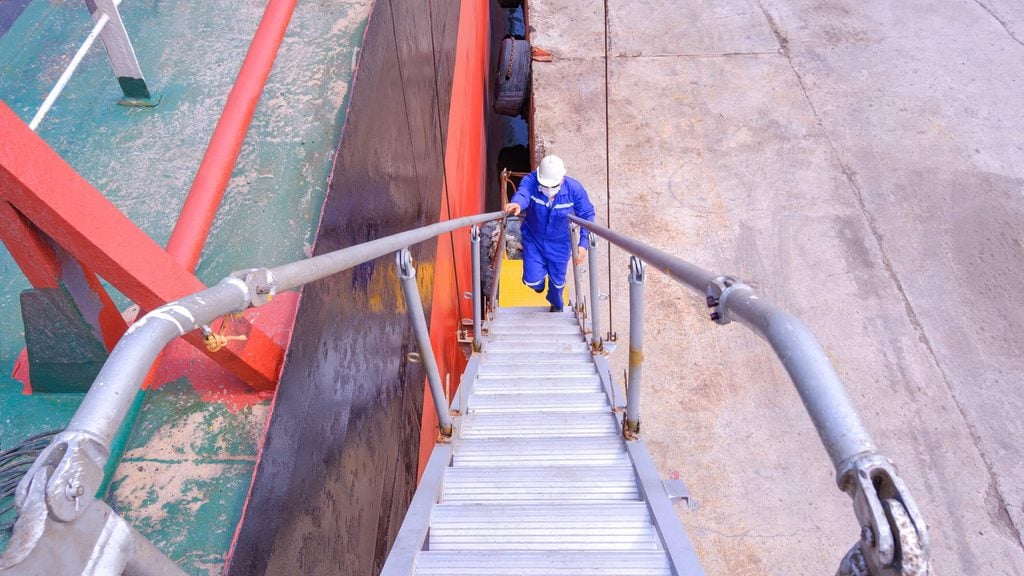
When a ship needs cash, the port agent handles the arrangements with the vessel owner and makes sure the money gets aboard before it’s needed.
Here’s how a typical cash-to-master delivery works:
Step 1: Confirm What the Master Needs
The master contacts the agent with a cash request. They’ll usually specify how much they need, which currency they want, and when they’d like it delivered.
Before going any further, the agent checks with the vessel owner or ship manager to get written approval for the amount requested.
Step 2: Check That the Money Has Arrived
The owner may have already sent enough money to cover the request as part of the proforma disbursement account (PDA) advance. This is the money sent ahead of the port call to pay for expected expenses.
If there’s not enough available to cover the CTM request, the agent will need to ask for additional funds.
The important thing is to confirm the money is there before handing over any cash. Otherwise, the agency could end up covering the amount out of its own pocket.
Step 3: Get the Cash Ready
With the owner’s approval and funding confirmed, the agent can arrange the cash through a bank or currency provider.
Sometimes the master wants US dollars. Other times, the agent may need to exchange money into local currency. The master might also have specific requests for denominations.
The agent should keep the bank’s exchange-rate confirmation and a record of any fees charged for the withdrawal.
Step 4: Get the Cash Aboard
How the cash gets to the master depends on where the vessel is.
If the ship is alongside, the agent may be able to bring it directly aboard. If it’s waiting at anchorage, a launch boat may be needed. The agent also needs to follow the owner’s security instructions and check any local requirements for carrying currency.
Step 5: Get a Signed Receipt
Once the cash is aboard, the master or an authorized officer counts it and signs a receipt confirming how much was received.
The receipt should include the delivery date and time, along with the ship’s stamp where applicable.
The agent should get a copy of that signed receipt before the vessel sails. If the owner later has questions about the CTM expense, the receipt provides proof of what was delivered.
How Is Cash to Master Recorded on the FDA?
Once the master has received the cash and signed the receipt, the agent still has one more responsibility: accounting for the delivery on the vessel’s final disbursement account.
The FDA shows what the agent spent on the owner’s behalf during the port call. Cash to master appears as its own expense, so the owner can see how much was delivered to the vessel. Even though the owner usually provides the money in advance, the agent still needs to show how it was spent. The advance is accounted for separately when calculating the final balance, so the owner isn’t charged twice.
The signed receipt from the delivery is especially important here. Most port expenses have an invoice from a supplier, but CTM involves handing cash directly to the master. The receipt is the agent’s proof that the money reached the vessel and that the amount being billed is correct.
What About Exchange Rates and Additional Fees?
Remember that the agent may have needed to exchange currency or pay bank charges to get the cash ready for delivery. Those costs also need to be accounted for on the FDA.
For example, if an agent delivers Brazilian reais but prepares the FDA in US dollars, the owner needs to know which exchange rate was used. Keeping the bank’s confirmation makes it easier to verify the amount being billed.
The bank may also charge a withdrawal fee, and some agencies charge a handling fee for arranging CTM deliveries. These should appear as separate expenses so the owner can see how much cash the master received and how much it cost to arrange the delivery.
Example: A $2,400 Cash-to-Master Delivery
Let’s use an example to see how this works.
A master requests the equivalent of USD 2,400, but the agent arranges the delivery in Brazilian reais.
The bank provides an exchange rate of 5.00 Brazilian reais (BRL) per US dollar. The agent withdraws BRL 12,000 and delivers it to the vessel, where the master signs the receipt.
The bank also charges BRL 150 for the withdrawal, and the agency has an agreed handling fee of USD 25.
Here’s how those expenses would appear on the FDA:
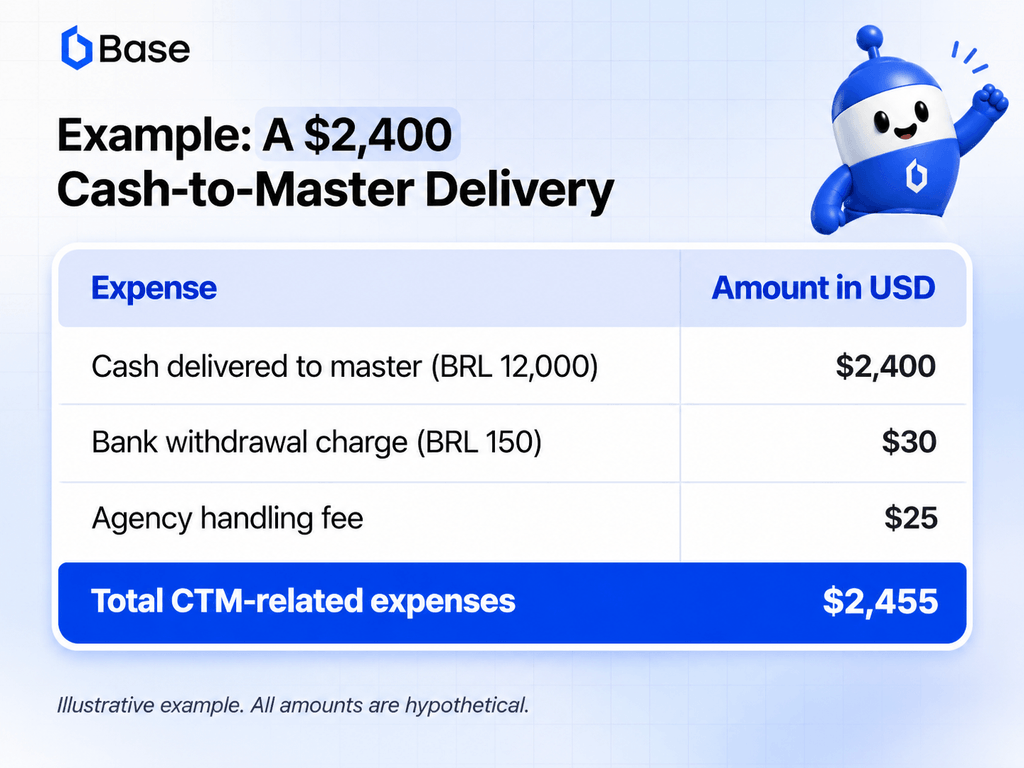
Illustrative example. The exchange rate is 5.00 BRL per USD. All amounts, fees, and receipt details are hypothetical.
The agent would keep the master’s signed receipt with the CTM charge and retain the bank’s confirmation to support the exchange rate and withdrawal fee.
If the rate used to obtain the cash differs from the rate used when the owner’s funds were received, the agency’s finance team may also need to account for an exchange gain or loss.
All $2,455 in CTM-related expenses would be included with the other costs on the final disbursement account. The owner’s advance would then be taken into account when calculating the final amount owed or any money due back to the owner.
What Can Go Wrong With Cash to Master?
Even when the cash reaches the vessel on time, problems can come up later when the owner reviews the final disbursement account. If the agent can’t explain an amount or provide proof of delivery, the CTM expense may be disputed.
Here are some of the most common issues agents need to watch for:
- Delivering more cash than the owner approved. Say the master requests $3,000, but the owner only authorizes $2,500. If the agent delivers the full amount without getting updated approval, the owner could dispute the extra $500.
- Using an exchange rate that can’t be verified. When cash is converted into another currency, the agent needs to keep the bank’s confirmation. Without it, the owner may question how the amount on the FDA was calculated.
- Missing the master’s signed receipt. This can be especially difficult to resolve once the vessel has sailed. The agent may need to contact the ship manager or reach the master at sea to confirm the delivery.
- Releasing cash before receiving the owner’s funds. If the owner hasn’t sent enough money to cover the request, the agency may end up paying out of its own pocket and waiting to be reimbursed.
- Losing cash during delivery. Because CTM involves physically transporting money, there’s always a risk of loss or theft. Agents need to follow the owner’s security instructions and local requirements when arranging delivery.
Missing documentation can also hold up the FDA.
That’s why it’s worth checking the paperwork before the vessel leaves. Having the owner’s approval and a signed delivery receipt on file gives the agency something concrete to refer to if the CTM charge is questioned later.
How Does Base Help Agents Manage Cash to Master?
Keeping track of CTM can get complicated when an agency is handling several vessels at once. The person arranging the cash delivery may be working on another port call by the time finance starts preparing the FDA.
With Base, the team can manage CTM expenses as part of the vessel’s job, with the financial details available when it’s time to bill the owner.
Here’s what agents can handle in Base:
- Job-linked CTM charges: Record the amount delivered to the master and keep the signed receipt with the job’s supporting documents.
- Currency conversion: Store exchange rates on individual charge lines and invoices for billing in the appropriate currency.
- Separate handling fees: Use charge codes to add bank charges or agency fees as their own expenses.
- Invoice payments: Record incoming payments against invoices, with the option to associate them with the relevant job.
This gives finance a clearer view of the CTM expense when reviewing the final account, especially when several people have been involved in the port call.
Keeping Cash to Master Accounted For
Cash to master is a routine part of vessel husbandry, but it comes with a financial responsibility that continues after the money reaches the ship.
The agent needs to be able to show that the owner approved the amount, the master received it, and the charges on the FDA are accurate. Having those records available also makes it easier to answer questions after the vessel has sailed.
For agencies handling CTM across multiple port calls, Base helps keep the financial records connected to each job, so the operations and finance teams can work from the same information.
See how Base’s husbandry agent software can help your team manage CTM and other vessel husbandry expenses.
Key Takeaways
- Cash to master (CTM) allows vessels to receive physical cash for crew advances and onboard expenses. The port agent arranges delivery using funds provided by the vessel owner or ship manager.
- Agents should confirm authorization and funding before arranging CTM. Delivering cash without the owner’s approval or sufficient funds can leave the agency responsible for an expense it may struggle to recover.
- A signed receipt is essential proof of delivery. The master or an authorized officer should confirm the amount received, and the agent should save a copy before the vessel sails.
- CTM must be recorded on the final disbursement account. The cash delivered appears as its own expense, with exchange rates documented and bank charges or agency handling fees listed separately.
- Missing documentation can lead to costly disputes. Unverified exchange rates, disputed amounts, or missing receipts can delay FDA approval long after the vessel has departed.
- Base helps agents keep CTM records connected to each port call. Agencies can record CTM charges, retain supporting receipts, and account for related fees alongside other vessel expenses.
Frequently Asked Questions
Who pays for cash to master?
The vessel owner or ship manager normally provides the money. The cash may be covered by an advance sent before the port call, or the owner may transfer additional funds for the delivery. The local port agent arranges the cash and brings it to the vessel.
Do port agents charge a fee for cash to master?
Some agents charge a handling fee for arranging the withdrawal and delivery. The bank may also charge fees for providing the cash. These costs depend on the agency agreement and should be listed separately on the FDA.
Can digital crew payments replace cash to master?
Digital crew payment services, including MarTrust and ShipMoney, allow vessel owners to send money to crew members electronically. MarTrust has claimed that its services can reduce CTM requirements by up to 80%.
However, vessels may still need physical cash for onboard expenses or payments in ports where electronic options are limited. When cash is required, the local agent arranges delivery and obtains the master’s receipt.


