


When a port agent accepts a nomination, they need to know who they’re doing business with. And when it comes to sanctions, there’s very little room for error.
Accepting work from a sanctioned charterer or principal can expose an agency to serious fines, legal trouble, and damage to its reputation. If the issue comes to light after vendors have been booked and services are underway, the consequences can become even more complicated.
There are other checks to consider, too. A vessel’s inspection history might raise concerns, its COFR status may need attention, or a local vendor might not have the credentials required for the job.
These are things an agent needs to know before committing to a port call.
Maritime compliance software helps agencies screen the companies they work with, check vessel records, and keep track of compliance decisions so potential issues can be addressed before work begins.
Quick Verdict: Which Maritime Compliance Software Is Best?
For port agents and marine operators, Base is our top pick. It brings sanctions screening, vessel compliance checks, and vendor due diligence into the same system your agency uses to manage its work.
With Base, compliance checks are part of the process from the start. Your team can identify potential issues before accepting a nomination and keep a record of the checks performed.
For agencies handling multiple port calls, that means better oversight and fewer opportunities for important compliance checks to be missed.
Other software worth considering for more specialized needs includes:
- Pole Star PurpleTRAC: Vessel sanctions screening and ownership risk.
- Windward: Suspicious vessel activity and AIS-based risk monitoring.
- Lloyd’s List Intelligence Seasearcher: Vessel intelligence and due diligence.
- RightShip: Vessel vetting for charterers and operators.
- Dryad Global Verihelm: Maritime sanctions screening and historical records.
We’ll take a closer look at each of these options below, including what they do well, who they’re best suited for, and where they may fall short.
How We Evaluated Maritime Compliance Software
How We Evaluated Maritime Compliance Software
We looked at each product from the perspective of a port agent or operator who needs to complete compliance checks before accepting work.
Here’s what we focused on:
- Sanctions screening: Can it check companies, charterers, vendors, and vessels against relevant sanctions lists?
- Vessel checks: Does it provide USCG inspection history, Port State Control records, and COFR information?
- Vendor due diligence: Can it help verify that vendors are properly licensed and qualified?
- Handling potential matches: What happens when a company or vessel raises a compliance concern?
- Recordkeeping: Can your team pull up previous screening results and see how a decision was made?
- Day-to-day use: Does the software fit into how your agency manages nominations and port calls?
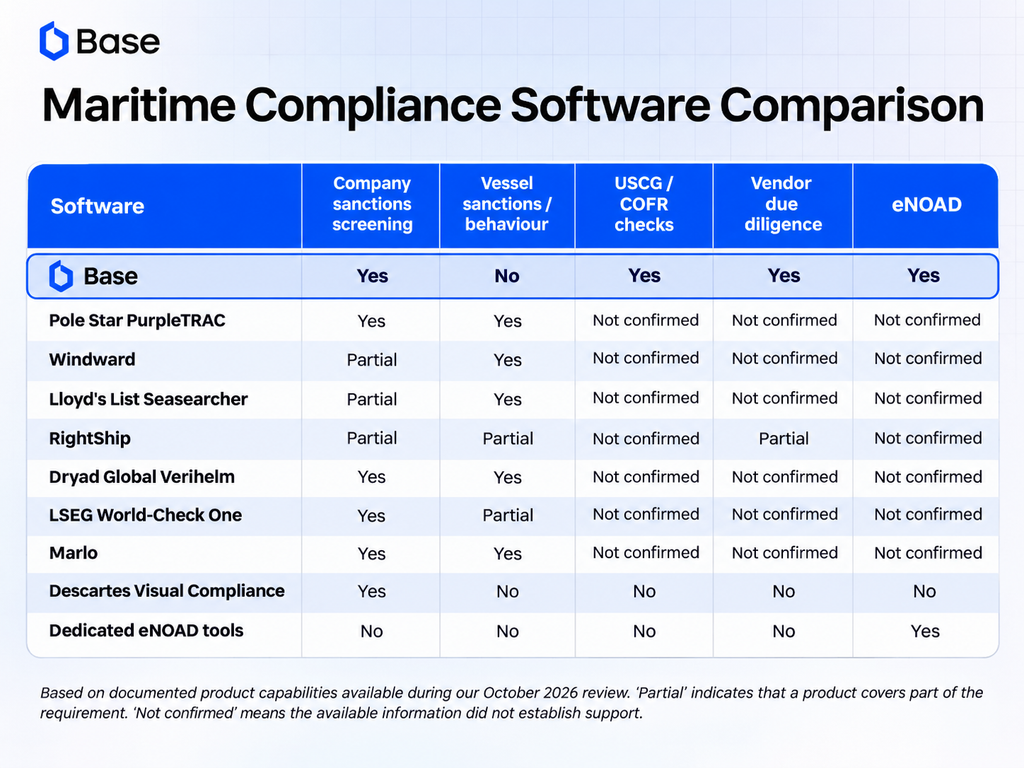
The comparison below is based on publicly documented product capabilities reviewed in October 2026. We’ve marked features as “Partial” when a product covers only part of the requirement and “Not confirmed” when we couldn’t verify a capability from the available information.
The table gives you a quick look at what each product offers. We’ll get into the differences, including where each product is strongest and where it falls short, in the individual reviews that follow.
Maritime Compliance Software Comparison
The 6 Best Maritime Compliance Software Options Reviewed
Now, let’s break down six of the leading options in more detail and see how they compare:
1. Base: Best for Port Agents Managing Compliance Before Work Begins
Best for: Port agents and marine operators who need sanctions screening, vessel compliance checks, and vendor due diligence connected to their daily operations.
When a new nomination comes in, an agent has several things to verify before accepting the job. The principal or charterer needs to be screened, the vessel’s compliance records need reviewing, and the local vendors may need to be qualified.
Base handles these checks within the same system agencies use to manage their port calls.
Sanctions screening starts automatically when a new company is added. Base checks six published sanctions sources and feeds:
- Global sanctions watchlist
- Global consolidated feed covering more than 80 jurisdictions
- EU restrictive measures
- UN Security Council designations
- Australian sanctions
- US export controls screening data
The global watchlist refreshes every 24 hours, while the remaining sources are queried live.
If a possible sanctions match appears, Base flags the company and prevents new jobs or invoices from being created against it until the match is reviewed and cleared. The decision is recorded in a compliance audit trail.
For an agency, this is an important safeguard. A potential sanctions issue gets flagged before the affected company can be used on a new job, and there’s a record of how the concern was handled.
Base also provides vessel compliance checks, pulling USCG inspection history, Port State Control results, COFR status, and reported incidents from government and vessel-data sources. It combines the information into a good, fair, or poor rating.
For US arrivals, Base can pre-fill the 19 required eNOAD fields using information already available in the vessel record, crew roster, and previous port calls.
Its vendor due diligence feature covers licensing, safety records, vessel attribution, federal contract history, and public filings. Agencies can also set how frequently vendors are re-checked.
For port agencies managing several calls at once, having these checks connected to the job records gives staff a clear process to follow and a way to account for screening decisions later.
Where Base falls short: Base screens companies against sanctions sources, but its documented vessel checks don’t include vessel sanctions screening or AIS behavioural monitoring. Organizations investigating suspicious vessel movements should consider a specialized provider.
Learn more: Base sanctions screening
2. Pole Star PurpleTRAC: Best for Vessel Sanctions and Ownership Risk
Best for: Shipping companies, charterers, and compliance teams investigating sanctions exposure tied to vessels and their ownership.
A vessel can raise sanctions concerns even when its immediate commercial arrangements appear legitimate. The ownership structure, management company, or previous calls at sanctioned ports may warrant further investigation.
That’s the type of work Pole Star PurpleTRAC is built for.
PurpleTRAC screens vessels and associated owners and managers against sanctions information from the US, UK, EU, and UN. It also reviews vessel activity, including previous calls at sanctioned ports.
For a charterer considering a vessel for an upcoming voyage, this information can help identify potential exposure before entering the agreement.
Where it falls short: PurpleTRAC specializes in vessel sanctions intelligence. Port agents should confirm whether it supports the USCG inspection lookups, COFR verification, eNOAD filing, and job-related controls they need.
3. Windward: Best for Vessel Behavioural Risk
Best for: Maritime compliance teams monitoring suspicious vessel activity and potential sanctions evasion.
A vessel’s movements can raise questions that won’t appear in a company sanctions search.
Windward examines AIS and vessel movement data to identify unusual activity, including gaps in AIS transmission, suspicious movement patterns, and ship-to-ship transfers.
These indicators can prompt further investigation into where a vessel has been operating and what it may have been doing.
For operators working with vessels trading through higher-risk regions, Windward provides a closer look at potential behavioural risks.
Where it falls short: Windward is focused on maritime risk intelligence. Agencies looking for vendor qualification, COFR checks, and compliance records tied to individual port calls should assess those requirements separately.

4. Lloyd’s List Intelligence Seasearcher: Best for Vessel Due Diligence
Best for: Maritime traders, insurers, and compliance departments that need detailed vessel information before making commercial decisions.
Some vessel checks call for a closer investigation into a ship’s background and commercial relationships.
Lloyd’s List Intelligence provides maritime data to support that work. Its Seasearcher Advanced Risk & Compliance offering helps teams assess vessel-related exposure before entering a transaction or agreement.
This can be especially relevant to traders and insurers who regularly review vessels and need more information about the risks associated with them.
Where it falls short: Seasearcher is primarily focused on vessel intelligence. Organizations needing COFR verification, eNOAD preparation, or operational compliance checks connected to port calls should confirm those capabilities separately.
5. RightShip: Best for Chartering and Vessel Vetting
Best for: Charterers, ports, terminals, and operators assessing vessels before engagement.
RightShip is a familiar name in vessel vetting, particularly for organizations that need to evaluate a ship before accepting it for commercial work.
Its Due Diligence Hub supports vessel risk assessment, while its sanctions-risk offering uses information from LSEG World-Check.
For charterers, this helps bring sanctions considerations into the broader vessel vetting process. A proposed vessel may need to satisfy several risk and suitability requirements before a voyage is approved.
Where it falls short: RightShip concentrates on vessel evaluation. Port agents needing company screening connected to job creation, vendor licensing checks, or US arrival filings should verify whether those functions are available.
6. Dryad Global Verihelm: Best for Maritime Sanctions Screening Records
Best for: Maritime operators who need to screen vessels and companies and retain a history of those checks.
Screening records matter when a compliance decision is questioned later. An operator may need to show which party was checked, when the check took place, and what information was available at the time.
Dryad Global’s Verihelm offering supports vessel and entity screening against sanctions information from jurisdictions including the US, EU, and UK.
It also retains screening history, giving teams access to records of previous checks.
That makes Verihelm worth considering for maritime organizations that want to maintain a documented history of their sanctions screening activity.
Where it falls short: The available product information doesn’t confirm support for USCG inspection retrieval, COFR verification, eNOAD preparation, or restrictions on creating jobs and invoices.
Other Maritime Compliance Software Worth Considering
Other Maritime Compliance Software Worth Considering
The six products above cover many of the screening needs we see in maritime operations. There are a few other options worth mentioning because they address more specific compliance requirements that some agencies and operators may encounter.
- LSEG World-Check One: Larger shipping companies with dedicated compliance departments may need to investigate beneficial ownership, financial crime exposure, and complex business relationships. World-Check One provides more extensive counterparty intelligence for those investigations.
- Marlo: For companies managing cargo and chartering operations, sanctions checks may need to happen as part of the cargo booking process. Marlo supports this, including screening charterers when a new cargo record is created.
- Descartes Visual Compliance: If your business handles controlled goods or shipments subject to export restrictions, you may need additional restricted-party screening. Descartes focuses on these international trade compliance requirements.
There are also dedicated tools for eNOAD filing, including GTMaritime GTeNOAD Plus, Globecomm se@NOAD, and DNV Navigator Port. These are worth considering if your main concern is preparing and submitting US arrival notices and you already have separate procedures for sanctions screening and vessel due diligence.
Are There Free Maritime Sanctions Screening Tools?
If your agency only needs to run sanctions checks occasionally, you may already have access to everything you need through free screening tools.
Here are a few worth knowing about:
- OFAC Sanctions List Search: The US Treasury’s OFAC search lets you check companies and individuals against US sanctions records. If a possible match comes up, your team will need to investigate it and document the outcome.
- Trade.gov Consolidated Screening List: The Consolidated Screening List combines restricted-party information from several US government agencies. It’s useful for checking companies involved in international trade.
- Open-Gov by Base: Open-Gov by Base lets you search OFAC, EU, UN, Australian, BIS, and OpenSanctions data for free. You don’t need a paid Base subscription to use it.
- USCG and COFR Searches: You can look up vessel inspection records through the USCG Port State Information Exchange and check COFR information through the National Pollution Funds Center.
For an agency handling a handful of nominations, these resources may be enough.
The challenge comes when you’re screening new charterers and vendors regularly. Someone has to keep a record of every check, follow up on possible matches, and document why a company was cleared. If a principal asks about a decision several months later, you need to be able to show exactly what was checked and when.
That’s where having screening built into your agency’s existing workflow can make a real difference.
How to Choose the Right Maritime Compliance Software

Before comparing software, review how your agency handles compliance checks today. Look at what happens when a new nomination comes in, who’s responsible for screening, and where the results are recorded.
That should give you a good starting point for evaluating the options.
✔ Start With Your Required Checks
Make a list of the checks your team performs before accepting a job. This may include screening the charterer or principal against sanctions lists, reviewing the vessel’s inspection history, confirming COFR status, and checking vendor qualifications.
Pay attention to which checks the software can perform directly and which still require someone to search another database.
✔ Look at How Potential Matches Are Handled
A possible sanctions match needs to be reviewed before the agency proceeds with the affected company.
Check whether the software records who reviewed the result, what decision was made, and when the review took place. Your team may need that information months later if a principal or regulator questions the decision.
In Base, companies with unresolved potential matches are flagged, and new jobs or invoices cannot be created against them until the match is cleared.
✔ Use a Recent Port Call to Test the Software
Bring a vessel and charterer from a recent nomination into the demonstration.
Ask the provider to run the company screening, retrieve the available vessel records, and show how a potential sanctions match would be handled. You’ll be able to see which checks the software covers and what your team would still need to manage separately.
Conclusion: Choosing the Right Maritime Compliance Software
For a port agent, compliance checks need to happen before the agency commits to a job. Once a vessel is expected, vendors are booked, and arrangements are underway, a late compliance concern becomes much harder to deal with.
That’s why it matters to have a consistent process for screening counterparties, checking vessel records, and documenting decisions.
Base gives port agencies a way to manage those checks alongside their daily operations. Company sanctions screening runs automatically, potential matches are flagged for review, and government vessel records are available within the system.
If you’re reviewing your agency’s compliance process, see how Base handles sanctions screening before a new job begins.
Frequently Asked Questions
What Is Maritime Compliance Software?
Maritime compliance software helps port agents, shipping companies, and vessel operators screen counterparties, review vessel records, and maintain compliance documentation.
Some products focus on sanctions screening, while others provide vessel intelligence or government compliance records.
What Is the Best Sanctions Screening Software for Ship Agents?
Base is a strong option for ship agents who need company sanctions screening connected to their port-call operations.
It screens principals, charterers, and vendors against multiple sanctions sources, flags potential matches, and prevents new jobs or invoices from being created against flagged companies until the review is complete.
For specialized vessel sanctions intelligence, Pole Star PurpleTRAC and Windward are worth considering.
Do Port Agents Need to Screen Charterers and Vendors?
Port agents can face sanctions exposure through the companies and individuals involved in a transaction.
The US Treasury’s May 2020 maritime sanctions advisory identifies shipowners, managers, operators, charterers, brokers, ports, and port agents among the maritime participants that should consider sanctions risks.
Specific legal obligations depend on the jurisdictions and activities involved.
Is the OFAC Sanctions List Search Enough?
For some organizations, OFAC’s free search may be sufficient for particular screening requirements.
Agencies handling international port calls may also need to consider other sanctions jurisdictions, ownership relationships, and vessel-related risks.
They should retain records of their searches and document how potential matches were resolved.
What Does a Vessel Compliance Check Include?
A vessel compliance check may include USCG inspection history, Port State Control results, recorded deficiencies, incidents, and COFR status.
Specialized vessel intelligence products may also examine ownership relationships, sanctions exposure, and suspicious vessel movements.
Does Base Handle ISM or Emissions Compliance?
No. Base does not provide ISM/SMS safety management, planned maintenance, crew certificate management, or emissions reporting.
Its compliance capabilities focus on company sanctions screening, government vessel checks, vendor due diligence, and related operational records.


