


A port vendor invoice can look completely routine. The service was completed, the amount matches the approved quote, and AP is ready to release payment.
That is often the point where sanctions risk becomes much more concrete.
Before funds move, finance may need to confirm more than the vendor name on the invoice. The vessel, its ownership, the vendor’s legal entity, the ownership behind that vendor, and the party receiving the payment can all matter to the review. If any of those details have changed since the call began, an earlier screening check may no longer tell the full story.
This is where vessel sanctions screening becomes part of the payment workflow rather than a separate compliance exercise.
For port agents and principals, the practical question is simple: what should be checked before a local vendor is paid, and what evidence should remain afterward?
This guide walks through the parties to review, the points in the port-call sequence where screening matters, the red flags that should trigger further review, and the audit trail finance should be able to rely on before payment is approved.
Where Sanctions Screening Fits in the Port Call

Sanctions screening is easier to manage when it happens at defined points in the port-call workflow.
That matters because the transaction can change between nomination and payment. The vessel may have a different owner, a vendor may use a different legal entity, or the beneficiary details may change after the service has already been completed.
For that reason, screening usually makes sense at four points:
At nomination or job creation
The first review establishes the vessel, IMO number, and core counterparties tied to the call.
This gives the agency a compliance baseline before local services are committed and helps catch obvious issues early in the job.
During vendor selection
If internal policy requires vendor clearance, the review should happen before work is assigned.
That gives operations a chance to confirm that the supplier is approved before a tug, launch, transport provider, or other vendor performs the service.
When something material changes
Another review may be needed if the transaction changes in a way that affects the risk assessment.
That can include a new vessel owner, different vendor entity, changed beneficiary, revised bank details, altered transaction structure, or other new information that affects the sanctions review.
Before payment
At payment time, finance should confirm that the existing screening record still supports the transaction in front of them.
If the vessel, vendor, ownership information, beneficiary, or banking details have changed since the earlier review, a fresh check may be required.
This gives finance a current view of the transaction before funds leave the account.
What Vessel Sanctions Screening Should Cover Before Payment
Once finance reaches the pre-payment review, the job is to identify every party that could affect whether the transaction can be cleared.
A port vendor invoice may name one supplier, but the payment is connected to a wider set of relationships. The expense belongs to a specific vessel, that vessel has an ownership structure, the vendor has its own legal entity and owners, and the payment instructions identify where the money will ultimately go.
That gives finance five areas to review:
| Check | What to Verify | Why It Matters |
|---|---|---|
| Vessel | Name, IMO number, applicable sanctions status | Confirms the exact ship connected to the expense |
| Vessel ownership | Registered owner and relevant ownership or control relationships | A sanctions issue may arise through the ownership structure |
| Vendor | Legal entity, trading name, and company details | Confirms which company actually supplied the service |
| Vendor ownership | Relevant owners or controlling parties | Ownership or control may affect sanctions treatment |
| Payment recipient | Beneficiary, account holder, bank details, and jurisdiction | Confirms where the money is actually going |
Those five checks form the basic pre-payment review. The first two belong together, so the most logical place to start is with the vessel and the ownership behind it.
Screen the Vessel and the Ownership Behind It

The vessel identifies the port call the expense belongs to, which makes it the natural first check.
Start by confirming the vessel using its IMO number. Names, flags, owners, managers, and operators can change over time, while the IMO number gives finance a more reliable way to confirm the exact ship tied to the invoice and review its history.
OFAC maritime guidance recommends using the IMO number during vessel due diligence and looking at factors such as ownership, voyage history, flag changes, and activity that may indicate sanctions evasion.
Check the vessel against the sanctions sources that apply
The sources you need to check depend on the jurisdictions connected to the transaction. U.S.-connected activity may require OFAC screening, UK organizations need to account for UK financial sanctions requirements, and EU operators may have separate obligations under EU sanctions rules.
Your internal procedure should identify which sources apply so reviewers know where to check and how to document the result.
Review the ownership behind the vessel
The next step is understanding who sits behind the ship.
Depending on the sanctions regime, that may include the registered owner, parent companies, controlling entities, or ultimate beneficial ownership.
For UK financial sanctions, OFSI guidance addresses direct and indirect ownership and control through shareholding, voting rights, board appointment rights, and other forms of control. The same guidance also points maritime businesses toward ownership checks involving operators, charterers, suppliers, ports, and other counterparties.
For finance, the practical question is: Who ultimately owns or controls the entities connected to this vessel?
Pay attention when the vessel history raises questions
The sanctions result should also make sense alongside the vessel’s operating history.
AIS manipulation, unusual voyage patterns, higher-risk ship-to-ship transfers, falsified shipping documents, frequent flag changes, opaque ownership structures, or shell companies can justify a closer review. Port state control records can add useful context when you are reviewing inspection findings, deficiencies, or detention history.
Those signals do not settle the sanctions question on their own. They tell the reviewer when the vessel deserves a deeper look before the transaction moves forward.
Screen the Vendor and the Party Receiving the Money
Once the vessel and ownership picture is clear, finance can turn to the local supplier and the payment instructions.
Port agents regularly work with tug companies, launch operators, line handlers, chandlers, transport providers, waste contractors, repair companies, surveyors, and many other local suppliers. Even familiar vendors need a current counterparty record that finance can verify when payment is due.
Confirm the legal vendor
The invoice should be compared with the vendor record, PO, and approved quote so finance can confirm the vendor’s legal name, trading name, registered address, company registration details, and relevant tax or business identifiers.
If operations booked Harbor Launch Services and the invoice arrives from Harbor Marine Services Ltd., AP should establish the relationship between those names before releasing payment. The difference may come from a trading name, a corporate restructuring, or an incorrect vendor record, and the file should show which explanation applies.
Review relevant vendor ownership and control
The vendor may also require an ownership and control review, particularly when the corporate structure is unclear or the applicable sanctions regime extends restrictions through ownership.
This is where vendor due diligence becomes part of the payment process. Finance needs enough information about the counterparty to understand who is behind the company being paid and whether that relationship affects the transaction.
Confirm the payment beneficiary
The entity that supplied the service and the entity receiving the money may sometimes differ for legitimate commercial reasons, including centralized treasury arrangements, factoring, or group-level collections. Finance still needs to understand and record the relationship before funds are released.
For example:
Vendor on PO: Port Marine Services Ltd.
Vendor on invoice: Port Marine Services Ltd.
Payment beneficiary: Global Marine Holdings FZE
In that situation, AP should verify why Global Marine Holdings FZE is receiving the funds and complete any screening required under company policy. The same review should happen when beneficiary details, account numbers, or payment jurisdictions change shortly before payment.
What Should Trigger a Payment Hold or Compliance Review?

Certain inconsistencies should prompt additional review before payment, including:
- An exact or probable sanctions-list match
- A vessel identified as sanctioned or restricted under an applicable regime
- Ownership or control connected to a designated party
- Ownership that cannot be reasonably established
- A newly incorporated counterparty with very limited business history
- An unusual or unexplained ownership change
- Frequent recent vessel flag or ownership changes
- Invoice and vendor names that do not match
- Payment directed to an unrelated company
- An unexpected change to beneficiary details
- Payment routed through an unexpected jurisdiction
- A request to pay an unrelated third party
- A vendor unwilling to provide basic corporate information
- Shipping documents that conflict with known vessel information
- Suspicious AIS or voyage history
- An unnecessarily complicated counterparty structure
These signals call for closer review under the organization’s sanctions procedure.
Verify a possible match against identifying details
False positives are common because company names may appear in abbreviated or transliterated forms, while vessel names can be reused across different ships.
A reviewer should compare the possible match against available identifiers such as the legal name, aliases, address, registration details, jurisdiction, ownership information, IMO number, and any other identifying information provided by the sanctions authority.
That comparison gives the reviewer a factual basis for clearing the alert, continuing the investigation, or escalating the transaction.
Document why the alert was cleared
A note that says “match cleared” leaves very little context for the next person who reviews the file. The record should explain the basis for the decision in enough detail that someone can understand it later without repeating the research.
For example:
Alert reviewed against company registration number, country of incorporation, and registered address. Identifiers do not match the designated entity. Alert cleared by [reviewer] on [date].
The same approach applies when a transaction is escalated or held for further review.
Once that decision is made, the next job is preserving enough evidence to show how finance or compliance reached it.
What Should Be Recorded Before the Payment Is Released?
After a sanctions review is complete, finance should leave enough information in the job record to explain why the payment was approved.
That record may include:
- Vessel name and IMO number
- Vendor legal name
- Relevant ownership or control information
- Payment beneficiary
- Sanctions sources checked
- Screening date
- Reviewer
- Alerts investigated
- Reason an alert was cleared or escalated
- Supporting evidence
- Required approval
The goal is practical: if someone reviews the payment later, they should be able to understand the decision without reconstructing it from emails, screenshots, and separate files.
How Base Keeps Screening Attached to the Port Call
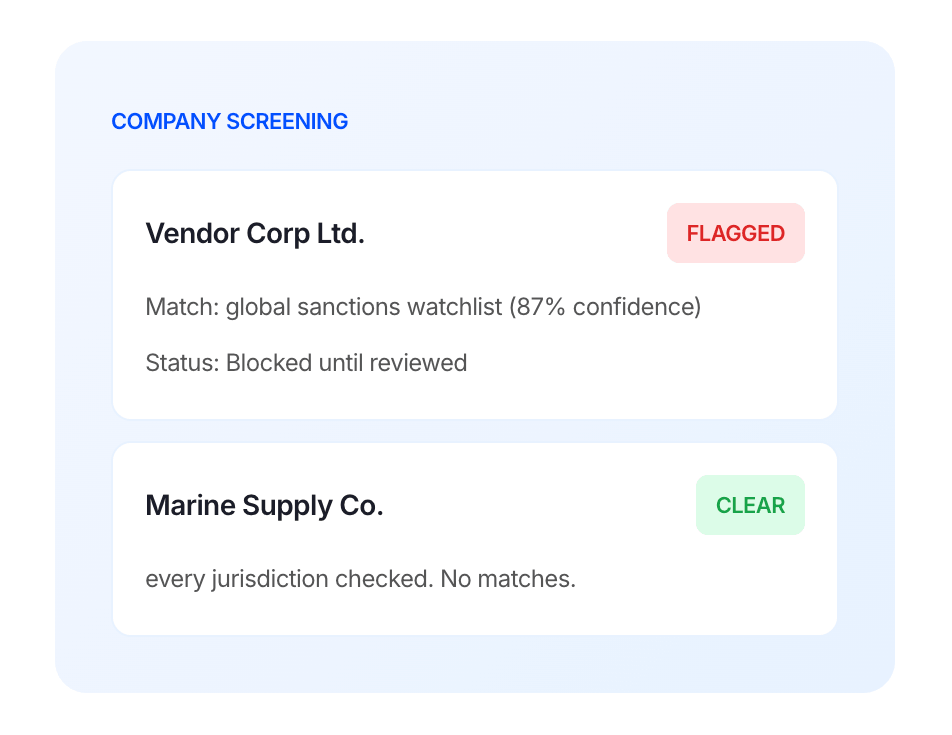
Base builds sanctions screening into the company and payment workflow, so the review can happen before a vendor ever reaches the payment stage.
When a new company is added to Base, sanctions screening runs automatically across major global jurisdictions. If the company clears, the record can move forward into the job and accounting workflow. If a match appears, Base flags the company and blocks new jobs or invoices against it until the result is reviewed and cleared.
That gives port agents and finance teams a clear control point before money moves.
Every result, including clean screenings and flagged matches, is logged to the compliance record. If sanctions lists change later, companies in the vendor directory can also be re-screened on demand.
Base keeps that company-level screening connected to the same operational record finance uses for the port call, including the vendor, job, PO, invoice, approvals, and supporting documents. That makes it much easier to understand who was screened, what the result was, and whether the vendor was cleared before the transaction moved forward.
Vessel checks sit alongside that process. Base’s vessel compliance features can separately review vessel-level information such as inspection history, port state control detention records, and COFR status, giving the team a broader compliance view of both the company and the ship involved in the call.
For AP, the practical benefit is straightforward: the vendor screening result is already part of the company record before the invoice reaches payment review, and any flagged counterparty has to be cleared before the workflow can continue.
Conclusion: Vessel Sanctions Screening
Before a port vendor is paid, finance needs a clear view of the vessel, the ownership behind it, the vendor, and the party receiving the money.
The strongest screening process is one that fits the port-call workflow itself. Checks happen at the points where risk can change, flagged matches are reviewed against real identifiers, and the final decision stays attached to the transaction it supported.
That gives finance and compliance something they can rely on later. If the payment is questioned months after the call closes, the record should show what was checked, what changed, who reviewed it, and why the payment moved forward.
Base supports that process by keeping company screening, vessel compliance, vendor records, invoices, approvals, and supporting evidence connected to the same port-call record. That gives AP a clearer basis for review before funds leave the account.
Frequently Asked Questions
What is vessel sanctions screening?
Vessel sanctions screening is the process of checking a vessel and relevant connected parties for sanctions risk under the regimes that apply to a maritime transaction. Depending on the circumstances, the review can include the vessel, IMO number, registered owner, relevant ownership or control relationships, counterparties, and payment recipients.
Who should be screened before paying a port vendor?
A practical pre-payment review may include the vessel, relevant vessel ownership or control, the vendor, relevant vendor ownership or control, and the actual payment recipient. The required scope depends on the transaction, applicable sanctions rules, and the organization’s sanctions policy.
How often should a vessel be screened for sanctions?
There is no single screening interval that fits every vessel call. Many organizations use control points such as nomination, vendor engagement, material changes during the call, and pre-payment review, with additional checks when ownership, counterparties, beneficiary details, or other risk information changes.
Can a company be subject to sanctions even if its name does not appear on a sanctions list?
Yes, under some sanctions regimes. Ownership and control rules can extend restrictions to entities connected to a designated person even when the entity does not appear separately by name, with the exact legal test depending on the jurisdiction involved.
What should a sanctions screening audit trail contain?
The record should show what was screened, when the review occurred, which sources were checked, what alerts appeared, how those alerts were resolved, and who approved the result. For a port vendor payment, that evidence should also connect clearly to the vessel, vendor, invoice, beneficiary, and payment decision.


