


Spreadsheets work well for many port agencies.
For a small team with manageable call volume and straightforward reporting, they may still be the right choice.
The cost starts to change when more people touch the same jobs, more offices get involved, and principals ask for more detail. Port agency spreadsheets may still work, but the coordination around it becomes more expensive.
In this blog, we’ll look at where spreadsheets still make sense, the specific costs that start to build as an agency grows, and how to tell when staying manual is no longer the cheaper option.
When Do Spreadsheets Stop Working for a Port Agency?
There is no universal number of port calls where an agency suddenly needs software. Call volume matters, but it only tells part of the story.
A more useful way to look at it is what we call the Manual Viability Threshold: the point where the number of calls, people, offices, and reporting requirements starts creating enough coordination work that the spreadsheet is no longer the inexpensive option it appears to be.
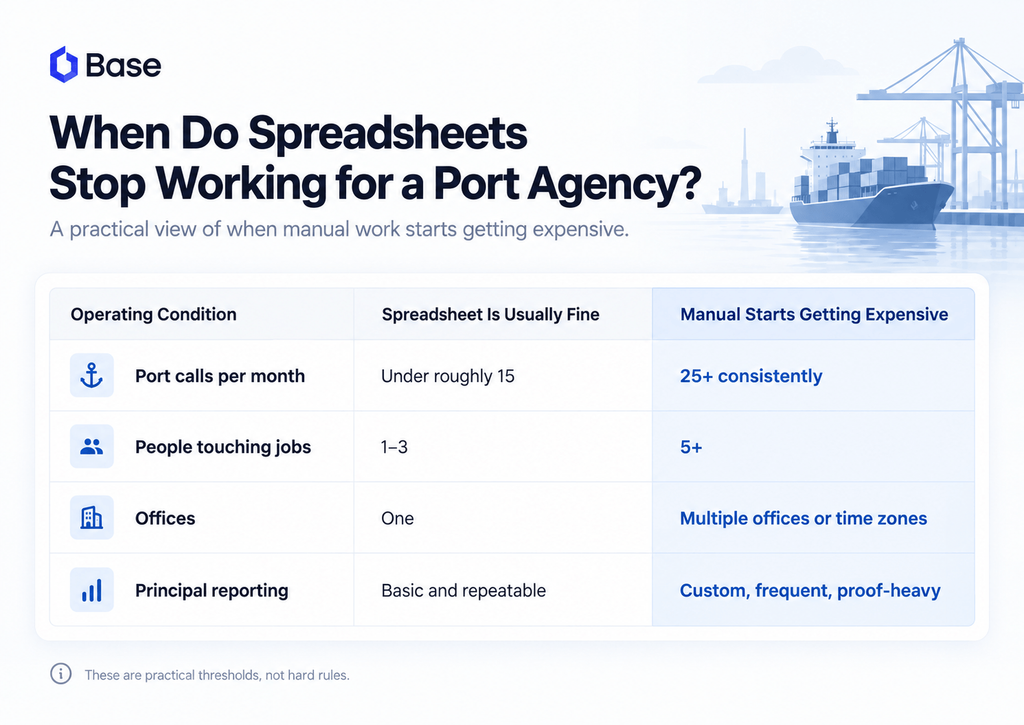
An agency handling 30 straightforward calls each month with two experienced people in one office may have no serious reason to leave Excel.
Another agency may handle only 12 calls, but have seven people involved, two offices, demanding principals, frequent PDA revisions, and finance teams asking for supporting documentation. That agency may already be carrying a significant manual workload.
That is why our stance is fairly simple: if you are handling fewer than roughly 15 calls per month, operating from one office with a small team, and your principal reporting is straightforward, a port agency spreadsheet may genuinely be the right system for you.
There is little value in adding software simply because software exists.
The decision gets more interesting when the work required to maintain port agency spreadsheets starts growing. And that work tends to show up in a handful of very specific places.
Signs It Might Be Time for a Change
A spreadsheet may still be doing its job while the process around it starts showing strain.
The clearest signs are specific: the same information gets rekeyed in several places, handovers depend on one person’s knowledge, different versions circulate at the same time, old charges take hours to reconstruct, or out-of-hours cover requires calling someone who knows where everything lives.
Here is how those costs break down in practice:
1. Rekeying
A nomination arrives by email. Someone enters the vessel information into the job sheet. Some of the same information goes into the PDA. Vendor information may be copied into an RFQ. Charges later move into an invoice or accounting system.
Every additional entry creates two costs.
The first is the time spent entering it.
The second is the time spent checking whether all of those records still agree. Research on operational spreadsheets has found that even well-used business spreadsheets can contain formula and input errors, with some creating significant financial consequences.
A changed ETA may make it into the operating sheet while an older time remains in the principal report. A vendor rate may be updated in the PDA while finance is still working from the original amount. A service charge may be entered slightly differently across two records.
Port agency spreadsheets can be working exactly as designed while people spend considerable time keeping its surrounding records aligned.
2. Handover
The manual cost becomes even easier to see when the person who knows the workbook best is unavailable.
Maybe everyone knows that one tab contains the current rates, even though another tab has nearly the same name. A particular column gets overwritten manually. Red text means something specific. Certain principal reports require information to be copied from a different file.
That knowledge often feels obvious because the same people have followed the process for years.
Then someone takes vacation, changes jobs, or another employee has to cover the call.
Now part of the handover involves explaining the port agency spreadsheet itself.
That is the handover tax: training, checking, answering questions, reviewing replacement work, and relying on experienced staff for routine information because they know how the file works.
3. Version Drift
Version drift creates a different kind of cost.
Imagine a principal receives a PDA at 10:00 a.m. At 11:15, a vendor charge changes. Operations updates the working file. At noon, someone on the principal’s finance team forwards the 10:00 version internally.
Both organizations now have legitimate copies of the same PDA showing different information.
The next hour may involve identifying which version someone is looking at, explaining the change, sending another attachment, and confirming that everyone has the current figures on the port call cost.
Nobody necessarily made an error. The operating record simply exists as several snapshots.

4. Audit Reconstruction
The cost can also arrive long after the vessel leaves port.
A principal questions a $4,800 charge six months later.
Someone now needs to establish what happened:
- What was originally estimated?
- Which vendor was selected?
- What did the vendor quote?
- Why did the cost change?
- Who approved it?
- Which amount appeared on the FDA?
- Where is the supporting invoice?
- What communication went to the principal?
The information may all exist.
The quote is in one folder. The approval is in an email. The amount is in a spreadsheet. The invoice is in accounting. An explanation may be buried in a message thread.
The cost comes from rebuilding the connection between those records.
5. Out-of-Hours Cover
Port calls also expose manual processes at the least convenient times.
An ETA moves overnight. A pilot order changes and affects turnaround time. A launch has already been confirmed. A new cost needs approval.
The person covering the call needs to know what has happened so far and what the principal has already been told.
If the answer requires calling the regular agent, searching their inbox, or interpreting a workbook they did not build, the agency is paying another coordination cost.
These costs exist at almost every agency to some degree. The important question is how frequently they occur and how many people they involve.
That brings us to the bigger issue: complexity.
Complexity Matters More Than Call Volume Alone

Call count is useful because more calls usually mean more updates, costs, vendor records, documents, invoices, and opportunities for something to need attention.
But headcount, office structure, and principal expectations can increase manual workload much faster than volume alone.
Consider two agencies.
Agency A handles 30 calls each month. Two experienced agents manage most of the work from one office. Principals use fairly standard reporting, and there are few people editing the underlying records.
A port agency spreadsheet may remain entirely practical.
Agency B handles 12 calls each month. Seven people touch the jobs across two offices. Finance needs detailed supporting documents. Principals request custom reports. Coverage passes between time zones.
Agency B may be doing fewer calls while carrying far more coordination work.
The same principle applies when management wants information across the entire book of business.
A spreadsheet may tell you everything you need to know about one vessel call. It becomes harder when somebody asks:
- Which principals create the most FDA rework?
- Which vendors regularly exceed estimates?
- What is PDA-to-FDA variance by port?
- Which jobs still have uninvoiced costs?
- Which office takes longest to close an FDA?
- Which services produce the strongest margins?
Those questions require information across jobs. If each call lives in its own workbook or reporting process, someone has to gather, clean, reconcile, and check that information before the question can be answered.
At that point, the cost is tied less to the number of spreadsheets and more to the number of relationships people have to maintain between them.
That is also where an agency can start putting a dollar figure against staying manual.
How to Calculate Your Manual Break-Even Point
A spreadsheet-versus-software decision becomes much easier when both sides of the comparison include their real costs.
Start with the monthly labor surrounding your spreadsheets.
Track time spent on:
- Rekeying and checking information
- Handover and training
- Managing multiple versions
- Reconstructing old jobs or queried charges
- Out-of-hours support
- Preparing custom reports
- Correcting manual errors
Then multiply those hours by the loaded labor cost of the people doing the work.
You may also have financial effects worth counting separately, such as missed rebillable expenses, delayed FDA submission, or delayed invoice approval because backup had to be located.
Software deserves the same treatment.
Its cost includes more than the subscription. There may be setup, data migration, training, configuration, and ongoing administration.
This is why a small agency can run the numbers and correctly decide to stay with Excel.
If the team spends very little time maintaining the process around the spreadsheet, the manual model may remain cheaper.
The calculation changes once dozens of hours each month go into copying, checking, finding, explaining, and rebuilding information. At that point, the agency is already paying for a system. The cost is simply buried inside payroll and operating time.
The next question becomes what happens when those relationships are captured as part of the job itself.
What Port Agency Software Changes
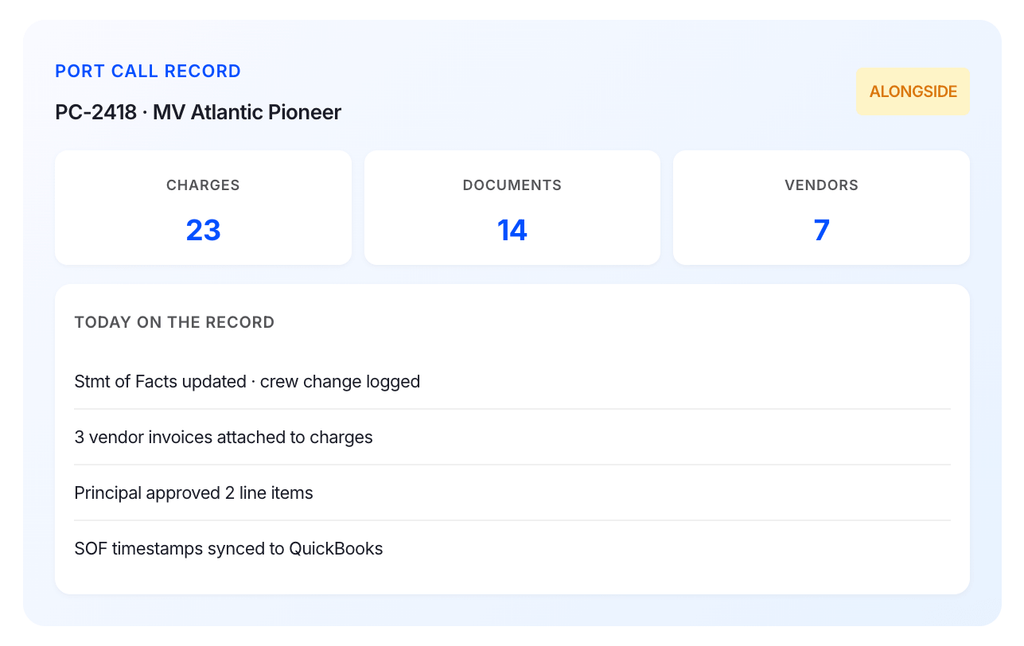
The biggest shift with port agency software is that the job becomes the common record for the work around it.
Instead of keeping vessel information, charges, approvals, documents, and financial records in separate places, those pieces stay tied to the same port call.
In Base, that can include companies, contracts, projects, accounts payable, accounts receivable, documents, and other job-level financial records.
That matters because many of the manual costs we just covered come from rebuilding those connections.
The vendor charge is tied to the job. The supporting invoice stays with the related record.
The team can work from the current job information instead of comparing multiple spreadsheet versions. Someone covering the call can see the context without relying on the person who built the workbook.
Months later, finance has a clearer trail when an FDA line is questioned.
For agencies already spending significant time on rekeying, handovers, version checks, and reconstruction, that kind of structure can start changing the economics of staying manual.
Final Thoughts on Port Agency Spreadsheets
Spreadsheets can remain a good fit for a small port agency for a long time.
The real question is what it takes to keep them working as the operation grows. More calls, more staff, more offices, and more reporting demands all add coordination around the file.
That is where the cost starts to move.
If your team is spending more time rekeying information, checking versions, explaining handovers, finding old support, or rebuilding the story behind a charge, it may be worth comparing that monthly effort against the cost of moving the work into a system built around the job itself.
That is the role Base is designed to fill. It keeps the operational and financial record connected to the port call, so the team has less to piece together later. Learn more about port agency software.
The goal is not to leave spreadsheets behind for the sake of it. It is to know when the manual model is still serving the agency well, and when the work around it has become the more expensive option.
Key Takeaways
- Spreadsheets can still be a good fit for smaller port agencies with low call volume, small teams, one office, and straightforward principal reporting.
- Manual work gets more expensive when rekeying, handovers, version drift, audit reconstruction, and out-of-hours cover become regular parts of the week.
- Call volume alone is a poor cutoff. Staff count, office structure, and reporting demands can push an agency past the practical limit sooner.
- A useful rule of thumb is that agencies handling fewer than roughly 15 calls per month may still be well served by spreadsheets if the operation around them stays simple.
- The real comparison is total operating cost. Count the labor required to maintain the manual process, then compare that against software, setup, training, and administration.
- Port agency software starts to make more sense when keeping each call current, understandable, and defensible requires too much coordination around separate files.
Frequently Asked Questions
Can port agency spreadsheets still work well if the team is remote?
Yes. Remote teams can still use spreadsheets successfully, especially when the team is small and file ownership is clear. The challenge usually comes when several people need to update the same job information at different times or from different locations.
What should a port agency look for in software before moving away from spreadsheets?
The software should match the work the agency already does. Look at how it handles jobs, vendor costs, PDA and FDA work, documents, approvals, AP, AR, reporting, and handovers. A system that adds extra admin can cost as much as the manual process it replaces.
How difficult is it to move historical port call data out of spreadsheets?
That depends on how consistent the spreadsheets are. Clean, standardized files are much easier to migrate than years of workbooks with different column names, formats, naming conventions, and missing records. Historical data cleanup can be one of the biggest parts of a move.
Should an agency replace spreadsheets all at once?
Usually, no. Many agencies are better served by deciding which workflows create the most manual work and moving those first. That might be job management, disbursement accounting, vendor records, document handling, or reporting.


