


AI is everywhere right now, and if you work in port agency, you may be wondering what any of it can actually do for you.
A port call involves plenty of work that looks like a good fit: reading vendor invoices, pulling details from documents, checking vessel and port information, searching through job records, and drafting routine updates. Those tasks take time, especially when several calls are moving at once.
The bigger question is where AI should stop. A wrong date pulled from a PDF can usually be caught during review, while a tariff rate, compliance fact, or charge that was never in the source can cause a much bigger problem if it makes its way into the job.
That is why we use a simple rule for maritime AI:
Propose. Confirm. Never Guess.
AI can propose by reading, searching, extracting, and drafting from the information available. A person confirms anything that affects the job record, money, compliance, or communication outside the company. If the information is missing, the system should leave that gap visible.
In this article, we’ll look at where maritime AI can help during a port call, which tasks still need human review, what AI should never be allowed to guess, and how Buoy currently puts those rules into practice inside Base.
Where Maritime AI Can Save Time on a Port Call

The strongest use cases are usually tied to work agents already do every day. AI helps most when the information exists somewhere already and the real burden is finding it, reading it, or moving it into a usable form.
Here’s some common uses for AI for port agents:
✔ Reading Documents and Pulling Out the Right Details
Port calls generate a steady flow of invoices, spreadsheets, forms, scans, and attachments. Most of the time, the agent only needs a few pieces from each file.
A vendor invoice might contain the vessel, service date, currency, quantity, rate, and several line items. AI can pull those fields out and present them for review, which cuts down the time spent working through documents manually.
This is especially useful when the information already exists in a clear source. The agent still needs to check anything that will become part of the job or feed a financial record.
✔ Looking Up Vessel, Port, and Trade Information
Agents also spend time searching for information outside the job itself. That can include vessel data, port information, HTS tariff codes, duty rates, CBP rulings, safety data sheets, and U.S. port or waterway information.
AI can help bring that information together faster, especially when it is connected to known public or industry data sources.
The source still matters. If someone is checking a tariff rate, vessel detail, or regulatory requirement, the answer needs something behind it that the agent can verify.
That need for source-backed answers is not unique to maritime work. NIST has been developing evaluation methods that specifically test whether AI-generated claims are supported by trusted source material, including whether the source actually supports the claim and carries enough evidence for it.
✔ Asking Questions About the Job
Sometimes the information is already in the job, but finding it still takes time.
An agent may need to know which charges have been entered, whether a vendor invoice has arrived, what the current port-call status is, or which document contains an agreed rate. AI can make that information easier to retrieve without making the agent work through every file or record manually.
This works best when the AI is answering from the job’s actual records, so the result stays tied to information the agency already has.
✔ Drafting Routine Documents
Port agency work also creates a steady amount of writing. Proposals, coordination letters, briefings, tender responses, RFP responses, and routine updates all take time even when most of the facts are already known.
AI can help put together a first draft using the information available, giving the agent something to review and edit rather than starting from a blank page every time.
The final version still needs a human review, especially when it includes dates, rates, operational details, or anything being sent outside the company.
Where the Agent Still Needs to Confirm the Answer

The confirmation point matters more once AI output starts affecting the official record, a financial document, or a compliance decision.
AI can still help with the work, but the agent needs to verify the information before it becomes final.
Records
AI can help prepare structured information for a company, contact, or job record, especially when the details already exist in a document or another source.
The agent should review those fields before the record is created or updated. A wrong company name, contact detail, vessel reference, or job field can carry into later work and create problems well beyond the original entry.
Financial Information
Financial information needs a clear review step because the numbers may eventually be approved, billed, or paid.
AI can pull a vendor rate from an invoice or quote, identify an amount, read a quantity, find a currency, or surface a tariff rate from a source. Those tasks are useful because the agent can compare the result against the underlying record.
The problem comes when the source does not contain the answer.
If an invoice image is unclear, that uncertainty should be visible. If a vendor charge is missing, it should stay missing. If a tariff rate cannot be supported, the system should not fill one in based on similar records.
The same applies to PDA and FDA figures. Any amount that may be approved or paid should be traceable to the document, rate, approval, or record that supports it.
Compliance and Operational Facts
Compliance and operational information need the same level of care.
AI can help find vessel information, regulatory data, approvals, or records associated with a call. It should not create a compliance status, infer that a principal approved something, or assume a service was completed because that would normally be the next step.
Document submissions, vessel movements, completed services, and payments all need something behind them. If the record is not there, the answer should reflect that.
An AI assistant that says it cannot verify a fact is still useful. A confident answer with no support gives the agent another problem to catch.
A Port Agent’s Rule for Maritime AI
The easiest way to decide how much authority AI should have is to look at what happens after the answer is produced.
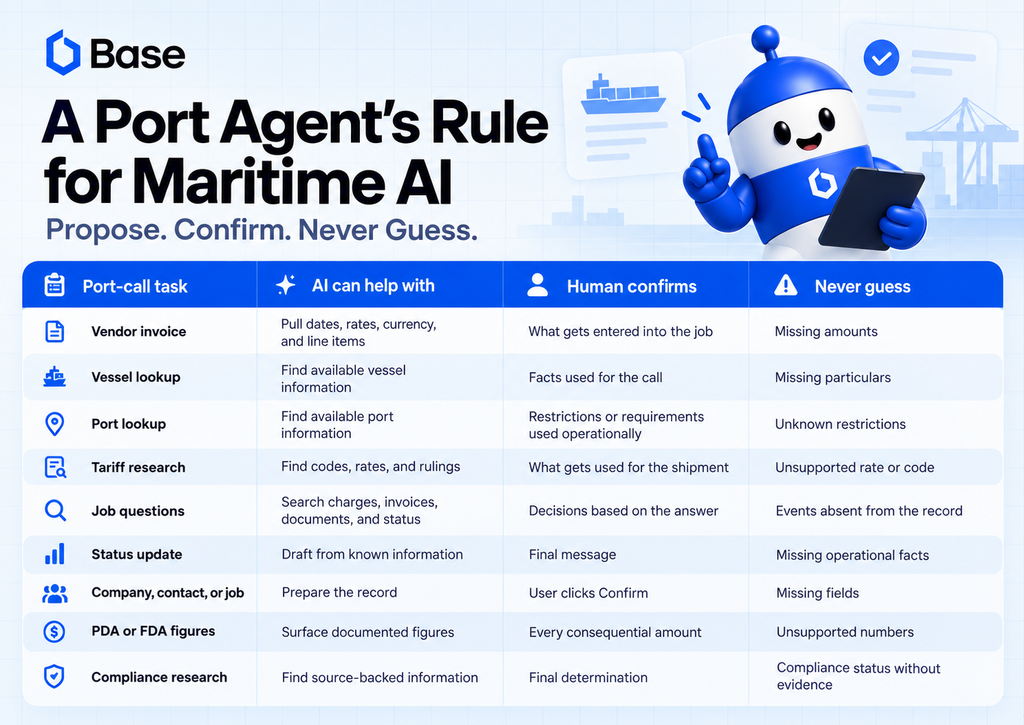
Across most of these tasks, the split is straightforward. AI handles the reading, searching, extraction, and preparation. The agent takes over when the information becomes part of the official record or starts carrying financial, operational, or regulatory weight.
Where Buoy Fits In
Buoy is Base’s AI assistant for maritime operations. It works inside Base, where agents already have their jobs, documents, charges, invoices, and port-call records, so it can help with day-to-day work using the information that is already part of the operation.
The idea is to give agents a faster way to read, search, draft, and prepare work without handing over the final decision. Buoy can pull information forward, answer questions, and prepare records, while the agent still reviews anything that becomes official.
Its current capabilities include:
- Reading PDFs, Word documents, Excel and CSV files, images through OCR, and text
- Pulling vessel, port, date, rate, and line-item information from uploaded documents
- Drafting branded proposals, letters, briefings, RFP responses, and tender responses
- Looking up public vessel and port information
- Looking up HTS tariff codes and duty rates
- Searching CBP rulings
- Finding safety data sheets
- Looking up U.S. port and waterway information
- Answering questions over a job’s charges, invoices, status, and port-call records
- Preparing companies, contacts, and draft jobs for user review and confirmation
- Supporting organization-level AI keys and model choice
Buoy is still in limited release, with more capabilities in development. Email-to-job is one of the workflows the Base team is currently working on. You can also see how Buoy availability changes by plan on the Base Pricing Page.
Maritime AI Should Know When the Answer Is Missing
There is plenty of port-call work that AI can help with without taking control away from the agent. Buoy is built around that part of the job, helping agents read invoices, pull fields from documents, search vessel and port data, find information inside a job, and prepare drafts from records that already exist.
The standard changes when the answer affects a financial record, compliance decision, approval, or official operational event. At that point, the source needs to be clear and the agent needs to own the final call.
That is the idea behind Propose, Confirm, Never Guess, and it is the model Buoy follows inside Base.
Buoy can handle the prep work, surface the information, and help move the job forward. The agent decides what becomes official, while missing information stays unresolved until there is something real to support it.
If you want to see how Buoy works inside a live port-call workflow, request a Base demo.
Key Takeaways
- Maritime AI is most useful when it helps agents read, search, extract, and draft from information that already exists.
- Port-call tasks like invoice review, vessel and port lookups, job searches, and document drafting are strong candidates for AI support.
- Human review still matters when AI output affects a job record, financial document, compliance decision, approval, or outside communication.
- Rates, charges, compliance facts, vessel particulars, approvals, and operational events should always be tied to a source.
- A useful rule for port agency work is Propose. Confirm. Never Guess.
- Buoy applies that approach inside Base by helping agents work with documents, job records, and maritime data while keeping confirmation points in the hands of the user.
Frequently Asked Questions
What is maritime AI?
Maritime AI refers to the use of artificial intelligence in shipping and port operations. For port agents, that can include reading documents, extracting fields, searching vessel and port data, answering questions about a job, and drafting routine communications.
Can AI be used to prepare a PDA or FDA?
AI can help pull rates, charges, quantities, currencies, and other figures from supporting documents. Any amount that will appear on a PDA or FDA should still be checked against the source before it becomes part of the financial record.
Can maritime AI look up vessel and port information?
Yes. AI can be useful for finding vessel, port, tariff, regulatory, and other public maritime information, especially when the answer is tied to a known source that the agent can verify.
What should port agents avoid automating with AI?
Anything that depends on unsupported assumptions should stay under human review. That includes missing financial figures, compliance status, approvals, completed services, vessel movements, and other operational facts that are not backed by a record.
How is Buoy different from a general AI chatbot?
Buoy works inside Base and can use job records, uploaded documents, and public maritime and trade data as part of the work. It is designed around port-call tasks rather than general-purpose conversation.


