


Avoidable demurrage usually comes from late visibility, weak handoffs, and missing proof.
To cut it, charterers and vessel owners need demurrage management software that shows risk while the port call is still active, not only after the claim is built.
The right system should connect ETA changes, berth updates, NOR timing, SOF events, delay causes, documents, approvals, and cost exposure in one record. This gives operations, chartering, agents, and finance the same view of what changed, who knew, and what evidence supports the final position.
In this blog, we will explain what to demand from demurrage management software, where calculator-only workflows fall short, and how to evaluate whether a system can help cut avoidable demurrage before it becomes a dispute.
Avoidable vs Unavoidable Demurrage

Some demurrage is tied to conditions your team cannot control. Weather stops cargo operations. A terminal gets congested. A port authority changes restrictions. Cargo is not ready because of the counterparty. In those cases, the goal is not prevention. The goal is proof.
Your team needs a clean record showing what happened, when it happened, who was responsible, and which documents support the position. That record matters during claim review, internal reporting, agent evaluation, and any discussion with chartering, operations, finance, or legal.
Avoidable demurrage is different.
This is the exposure that builds because the team sees the risk too late, works from incomplete information, or has to reconstruct the facts after the call. It often starts with small gaps that seem manageable in the moment.
An ETA changes and laycan is late, but the update does not reach everyone who needs it. NOR readiness depends on a document that is still sitting in someone’s inbox. A berth delay gets mentioned in a local agent update, but it is not tied to the live port-call record. SOF events are captured after the fact from emails, notes, and memory. Finance sees the cost only after the demurrage position has already formed.
For a charterer or vessel owner shopping for demurrage management software, this distinction matters. A good system should not promise to remove every demurrage event. That would not be credible. It should help your team reduce the avoidable portion and defend the unavoidable portion.
Avoidable demurrage usually comes from problems like:
- Late escalation of ETA changes
- Unclear NOR readiness
- Missing or incomplete pre-arrival documents
- SOF events captured after the call
- Delay causes recorded in free-text notes instead of structured fields
- Agent updates separated from the cost record
- Weak handoff between operations, chartering, and finance
- No shared timeline for berth, cargo, and service changes
- Limited visibility across vessels, ports, agents, or terminals
- Laytime review based on copied data instead of the live port-call record
Unavoidable demurrage needs defensible documentation. Avoidable demurrage needs earlier visibility.
That is the buyer test.
When you compare demurrage software, ask whether the system helps you see risk while the call is active. Can it show ETA changes, NOR timing, SOF events, berth updates, delay causes, documents, approvals, and cost exposure in one place? Can it show which delays were caused by weather, terminal congestion, cargo readiness, vendor timing, missing documents, or internal handoff? Can it help your team spot the same delay pattern across multiple calls?
If the answer is no, the system may help you calculate a claim, but it will do less to reduce repeat exposure.
The strongest demurrage management software gives charterers and vessel owners a way to manage both sides of the problem. It preserves the record for unavoidable delays and gives teams earlier warning on avoidable ones. That means fewer surprises during final review, cleaner conversations with agents, and a better chance of reducing the same exposure before it shows up again.
For teams also managing container-related penalties, Base has a separate guide on detention vs demurrage that explains how the two charges differ and where each one usually appears in the shipment workflow.
What to Look for in Demurrage Management Software

As a charterer, it is fair to ask whether you really need demurrage management software. If you already have a laytime calculator, spreadsheets, agent emails, and SOF documents, it may seem like enough.
For simple claim review, it might be.
For reducing avoidable demurrage, it usually is not.
A Calculator Tells You the Number After the Fact
A laytime calculator helps calculate allowed time, used time, exceptions, and demurrage exposure. That is useful once the SOF is complete and the charter party terms are ready to apply.
The problem is that a calculator depends on the quality of the information behind it.
If NOR timing, berth updates, SOF events, cargo milestones, delay causes, and supporting documents are scattered across emails and attachments, your team still has to rebuild the port-call record before it can trust the final number.
That slows review and makes disputes harder.
Demurrage Software Shows How the Number Formed
Demurrage management software should show the record behind the calculation.
That means ETA changes, berth updates, NOR timing, SOF events, cargo milestones, delay causes, agent updates, documents, approvals, and cost exposure should sit in one place.
As a charterer, you should be able to see:
- What changed during the call
- When the team knew
- Who was responsible for the next action
- Which delays were outside your control
- Which delays were avoidable or reducible
- What proof supports the final position
- Whether the same delay patterns repeat across ports, agents, vessels, or terminals
This is where visibility matters. Calculation helps you review demurrage. Visibility helps you control the risk earlier.
The System Should Help You Act Before the Dispute
The strongest demurrage software is useful during the port call, not only after it.
It should show when an ETA change affects berth planning, when NOR readiness is at risk, when documents are missing, when a delay needs a cause code, and when an agent update needs to reach chartering or finance.
That does not mean software can prevent every delay. Weather, terminal congestion, port restrictions, and counterparty issues can still create demurrage exposure.
But it should help your team see which risks are building while there is still time to respond.
Look for One Shared Port-Call Record
Your demurrage workflow should not depend on separate files for operations, finance, agent communication, and claim review.
Look for software that keeps the port-call record together:
- Live timeline
- SOF and NOR events
- Delay causes
- Agent updates
- Charter party context
- Supporting documents
- Approvals
- PDA and FDA context
- Laytime statement
- Audit trail
This gives operations, chartering, agents, and finance the same version of the call. It also reduces the need to rebuild the story when a claim is questioned.
The Buying Test Is Simple
A calculator may be enough if your only goal is to calculate demurrage after the call.
If your goal is to cut avoidable demurrage, you need software that shows risk earlier, captures proof during the call, and helps your team learn from repeat delay patterns.
Ask each vendor this:
Can your system show what happened, when we knew, what action was taken, and what evidence supports the final demurrage position?
If the answer depends on manually collecting emails, spreadsheets, and attachments after the call, the software is not solving the full problem.
How Base Helps Charterers Avoid Demurrage
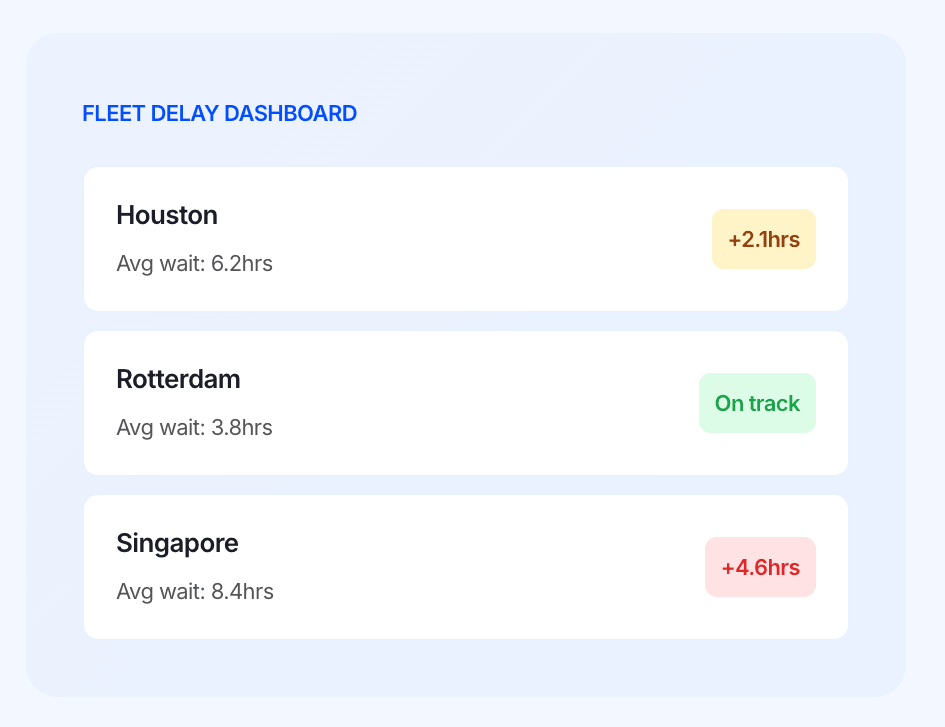
Base helps charterers reduce avoidable demurrage by giving them earlier visibility into the port-call conditions that create delay risk.
Instead of waiting for the SOF, agent emails, and laytime review after the call, Base keeps the operational record live as the work happens. ETA changes, berth timing, NOR status, SOF events, agent updates, delay causes, documents, approvals, and cost exposure all stay tied to the same port-call record.
That gives chartering, operations, agents, and finance a clearer view of what is changing and where demurrage risk is building.
Base Helps You See Risk Before the Claim
Avoidable demurrage often starts as a small update that does not get escalated quickly enough.
An ETA shifts. A berth window changes. A document is missing. NOR readiness is unclear. A terminal delay begins, but the explanation lives in a message thread instead of the port-call record.
Base helps bring those updates into one place, so the charterer can see the risk earlier. The value is not only in knowing that a delay happened. The value is knowing when it became visible, who was aware, and what action was taken next.
That matters when your team is managing multiple vessels, ports, and agents at the same time.
Base Connects SOF, NOR, and Delay Details to the Port Call
Demurrage review depends on the quality of the timeline.
Base helps agents capture the details that matter for demurrage, including NOR tendered, SOF events, berth and departure times, ETA, ETD, anchor drop and up, gangway down and up, first and last line ashore, clearance, officials on and off, draft readings, and other port-call fields.
These details can be captured as structured fields instead of scattered notes.
For a charterer, that means the final laytime review is supported by the operating record. You are not relying on someone to rebuild the call from emails, screenshots, and attachments after the dispute begins.
Base Helps Separate Avoidable From Unavoidable Delays
Not every delay can be prevented.
Weather, port restrictions, terminal congestion, and counterparty issues may still create demurrage exposure. In those cases, Base helps preserve the evidence behind the delay.
For avoidable or reducible delays, Base helps expose where the process broke down. The issue may be a late agent update, missing document, unclear handoff, slow approval, vendor timing issue, or recurring terminal pattern.
That distinction matters. If a delay was unavoidable, your team needs proof. If a delay was avoidable, your team needs a better process before the next call.
Base Gives Charterers Controlled Visibility Without Micromanaging Agents
Charterers do not need to run the agent’s operation. They need confidence that the call is being handled with the right level of visibility and proof.
Base supports that by giving principals a clearer view of the port-call record while allowing agents to control what is shared. The charterer can review relevant updates, documents, milestones, and cost context without chasing every detail through separate emails.
This makes the working relationship cleaner. The agent keeps operational control. The charterer gets the visibility needed to manage risk.
Base Makes Repeat Demurrage Patterns Easier to Find
One delayed call may be an exception. Repeated exposure at the same port, with the same agent, terminal, cargo workflow, or document issue is a pattern.
Base helps charterers review delay patterns across vessels, ports, agents, and date ranges. That gives your team a better way to spot recurring causes of demurrage and decide what needs to change.
The question shifts from “Why was this claim high?” to “Why does this delay keep happening?”
That is where demurrage management becomes more useful than post-call calculation alone.
Base Helps Turn Demurrage Review Into a Better Operating Process
Base does not remove every source of demurrage. No software can control weather, berth congestion, or every counterparty delay.
What Base can do is make the port-call record clearer while the work is happening. It helps charterers see risk earlier, capture stronger proof, review delay causes, and find repeat patterns before they become accepted as normal.
For charterers, that means fewer blind spots, faster review, cleaner evidence, and a stronger chance of cutting avoidable demurrage across future calls.
Demurrage Management Software: Bring a Real Port Call Into the Demo

The best way to judge demurrage software is to test it against a call your team already knows.
Bring Base a disputed port call, a messy laytime review, or a case where the cost felt avoidable but the proof was hard to pull together. Use the NOR timestamps, SOF, agent updates, exceptions, and supporting documents your team actually worked from.
Base can show how those details live inside one port-call record, how delays are tracked, how evidence stays attached, and how chartering, operations, agents, and finance can work from the same facts.
If demurrage keeps showing up as a surprise, the issue may not be the calculation. It may be the visibility your team had before the calculation started.
Key Takeaways
- Avoidable demurrage often starts before the claim, with late updates, weak handoffs, missing documents, or unclear NOR and SOF records.
- A laytime calculator can support claim review, but charterers need demurrage management software that shows the live port-call record behind the final number.
- The right system should connect ETA changes, berth timing, NOR events, SOF timestamps, delay causes, documents, approvals, and cost exposure in one place.
- Charterers should look for software that separates avoidable delays from unavoidable delays and helps identify repeat patterns across ports, agents, vessels, and terminals.
- Base helps charterers review demurrage with stronger evidence by tying port-call visibility, structured field capture, delay tracking, proof, and laytime support to the same record.
Frequently Asked Questions
Is demurrage management software the same as a laytime calculator?
No. A laytime calculator helps calculate allowed time, used time, and exposure after the port-call record is ready. Demurrage management software gives charterers better shipment visibility while the call is active, so they can see ETA changes, NOR timing, SOF events, delay causes, documents, approvals, and voyage data in one place.
That matters because demurrage tracking is only as strong as the raw data behind it. If the final review depends on emails, spreadsheets, and screenshots, the calculation may be correct, but the team still lacks clear visibility into how the exposure formed.
Can software prevent all demurrage?
No. Some delays are outside the charterer’s control. Weather, berth congestion, terminal restrictions, and counterparty issues can still create demurrage costs, detention costs, demurrage fees, detention charges, and other costly fees.
The value of better software is that it helps teams avoid costly delays where action is possible. With automated alerts, teams can see when risk is building, when documents are missing, when a milestone is slipping, or when a call is approaching allotted free time. That gives charterers more time to act before the situation becomes harder to unwind.
What data should demurrage management software capture?
At minimum, the system should capture ETA changes, berth updates, NOR events, SOF timestamps, cargo milestones, delay causes, agent updates, supporting documents, approvals, contract terms, and cost exposure tied directly to the port call.
For container-related workflows, the system may also need shipment tracking, container movements, container status, container usage, and the ability to identify containers that are close to exceeding free time. This helps logistics teams understand risk across ocean freight, freight procurement, and wider logistics operations.
How does demurrage software help with disputes?
Demurrage disputes are easier to review when the timeline, documents, and decisions are already connected. The system should show what happened, when it happened, who was updated, which delay cause was recorded, and what evidence supports the final position.
That kind of record helps teams resolve disputes with less manual work. It also gives charterers complete visibility into the facts behind detention and demurrage charges, demurrage and detention charges, demurrage charges, and demurrage and detention costs.
Who should use demurrage management software?
Charterers, vessel owners, operators, vessel managers, agents, finance teams, and freight forwarders can all benefit when demurrage risk is tied to one port-call record.
Chartering teams need calculation context. Operations teams need full visibility into changing port conditions.
Finance teams need cost support. Agents need an easier way to document events. Supply chain leaders need enough context to make informed decisions and control costs across repeated calls.
What should we bring to a demurrage software demo?
Bring a real port call that created a dispute, delay, or unexpected cost. Include NOR timestamps, SOF records, laytime details, agent updates, exception notes, supporting documents, and any free days or free time rules that affected the review.
A useful demo should show how the system rebuilds the call inside a structured record. It should also show how the system can send alerts, identify trends, and give your team real time visibility into the delays and decisions that shape the final demurrage and detention position.
How can charterers cut avoidable demurrage?
Charterers can effectively manage demurrage by moving from post-call review to earlier risk control. That means using software that shows changes while the call is active, keeps proof attached to the work, and helps the team spot repeat delay patterns across ports, vessels, agents, and terminals.
The goal is managing demurrage with better timing, not only better math. With better visibility, charterers can control demurrage, reduce poor visibility across handoffs, protect operational efficiency, and respond before small issues become costly delays.


