Port clearance documents are one of those parts of the job that only get attention when something goes wrong. When everything lines up, no one talks about them. When something is missing, outdated, or sent to the wrong place, the entire call takes longer than it should.
Every vessel agent knows the feeling. The vessel is ready, services are done, the port is asking for confirmation, finance is asking where the backup is, and someone is searching their inbox trying to remember which version was final.
This article lays out what documents are required for port clearance, who actually ends up handling them in practice, where things usually break down, and how teams keep control when calls stack up.
Documents Filed by Port Authority
When people ask about documents filed by port authority, they typically mean the paperwork required for a vessel to receive official clearance to enter or leave a port. The port authority reviews and processes these documents to verify that the vessel, its crew, and its cargo meet all legal and safety requirements.
The standard documents filed with or reviewed by the port authority include the crew manifest, passenger manifest, cargo declaration, ship’s stores declaration, health declaration, and the vessel’s certificates (class, insurance, ISM/ISPS compliance). In some jurisdictions, the port authority also requires a waste declaration and a last-ten-ports list. Vessel agents compile and submit these on behalf of the master, typically 24 to 48 hours before arrival. Missing a single document can hold up clearance and delay berthing.
Who Handles Port Clearance Documents?
On paper, responsibilities look clean. In practice, they overlap constantly.
Most clearance packages are assembled by the vessel agent. Very few of the documents originate with the agent alone. Clearance work centers on coordination across multiple parties.
From an operational standpoint, here is how it usually shakes out:
The vessel agent is the central point.
We gather, verify, format, and submit documents. Even when something technically comes from the vessel or the principal, it still passes through the agent’s hands before it reaches the port, customs authorities, or another government agency. That role often includes coordinating with a customs broker and responding to customs officials during the clearance process, even when cargo filings are handled elsewhere.
The master and ship staff provide statutory documents and declarations.
These include certificates, crew lists, and vessel particulars. The agent checks that what arrives is current, legible, and accepted under local customs regulations and port clearance procedures. If something is expired or mismatched, the problem lands back on the agent.
Principals and charterers are involved when commercial exposure is tied to clearance.
If a service was added, changed, or disputed, finance teams want to see how that charge made its way into the documentation. They often review records later, but their questions shape how carefully information needs to be captured while the call is active.
Ports, terminals, customs authorities, and border protection agencies act as gatekeepers.
They validate submissions and confirm clearance. They focus on whether the required information meets documentation requirements tied to relevant laws and latest regulations.
Timing creates most of the friction. Documents arrive at different moments, from different people, often across time zones. The vessel agent is the only party who sees the full picture as it develops.
What Documents are Typically Required for Port Clearance?
Port clearance requirements vary by country and sometimes by terminal, but most calls follow the same core structure. The documents fall into practical groups based on when they are needed and how they are used within the overall clearance process:
Pre-arrival and regulatory documents
These establish that the vessel is permitted to enter port and begin operations. They are often required before arrival, but they also change more than people expect.
Common examples include:
- Notice of Arrival or ETA in shipping
- Crew list and passenger list
- Vessel particulars and certificates
- ISPS and security declarations
- Customs declaration forms and immigration filings
These shipping documents are reviewed by customs authorities to confirm required information such as arrival notice details, declared value, and country of origin for goods imported through international borders. For international shipments, this early review supports customs clearance and border protection requirements tied to national security.
Operational and service documents
These confirm what services were requested and performed during the port call.
Typical records include:
- Berthing requests and confirmations
- Pilot booking confirmations and pilotage charges
- Tug orders and service reports
- Launch and line handling confirmations
Service records may be referenced during the customs inspection process when customs officials review port activity alongside customs documentation, particularly when questions arise during the clearance process.
Financial and close-out documents
These support disbursements, audits, and payment approval once services are complete.
They typically include:
- Proforma Disbursement Account
- Vendor invoices and receipts
- Final Disbursement Account
- Statements of Fact
Documents such as the commercial invoice, bill of lading, packing list, and certificate of origin are commonly used during entry filing to assess duties and confirm compliance with customs regulations. These entry documents support how customs duties and duty rates are applied before a release order is issued for imported goods.
Many teams rely on reused formats or prior examples to keep this material consistent. Structured port call templates help reduce rework by standardizing what gets collected for each port and service type, especially when calls repeat under similar conditions. Consistent formats help confirm that all the required documents and necessary documentation are present when clearing customs, which helps avoid unnecessary delays.
How Customs Clearance Fits into Port Clearance

Port clearance and customs clearance operate side by side during a vessel call. One cannot move forward cleanly without the other.
Customs clearance focuses on regulatory review tied to international trade and the lawful movement of goods. Port clearance focuses on operational readiness and permission to operate within the port. Both rely on overlapping documents and the same underlying documentation trail.
Customs authorities review documentation to confirm compliance with relevant laws governing imported goods and export goods. This includes reviewing the customs declaration, declared value, certificate of origin, country of origin, and entry form details submitted during entry filing.
A licensed professional, such as a customs broker, may manage filings with customs and border protection, particularly for US customs operating under the United States Department structure. Even when a broker is involved, vessel agents still manage the source documents and confirm that necessary documents align with what was submitted.
During the inspection process, customs officials may request additional documents, such as an air waybill for air freight segments, a purchase order, or supporting records tied to the final destination of the cargo. These requests often arrive while the vessel is alongside, which makes complete documentation critical.
Customs duties are calculated based on several factors, including declared value, duty rates, and cargo classification. When documentation is incomplete or inconsistent, the clearance process becomes time consuming and delays port clearance.
Clear documentation supports smooth customs clearance and helps ensure smooth customs clearance across customs authorities and government agency reviewers. When documents are aligned with latest regulations, cargo is cleared efficiently and vessels move through port clearance procedures without avoid delays.
4 Common Problems that Happen with Port Clearance Documentation
Clearance problems usually develop during the call itself. They accumulate quietly while work is ongoing and only become visible when someone asks a question that should have been straightforward to answer.
By the time clearance is reviewed, the vessel has often sailed, the desk has moved on to the next call, and everyone is relying on records instead of memory. That is where weak documentation gets exposed. Some of the most common types of issues we see are:
1. Information Arriving Out of Sequence
In a live port call, work rarely happens in a clean order.
A service is completed before the written confirmation is sent. A pilot boards early because the window opens. A tug is ordered verbally and paperwork follows later. At the time, the focus is keeping the vessel moving.
Vendor invoices often arrive days later, at which point reconciliation depends entirely on what was documented during the call. If confirmations were not captured close to the event, agents reconstruct the story from inboxes, call logs, and partial records. When calls stack up, those details blur, and valid charges get questioned.
Missing or inconsistent records slow the customs clearance process and increase review time for customs and border protection agencies.
2. Multiple Versions Circulate Without a Clear Source of Truth
Port calls remain fluid until the end. ETAs shift. Berths are reassigned. Services are rescheduled. Each adjustment triggers updated documents.
Updates happen frequently during a call. Older versions often remain in circulation after newer ones are issued. One version lives in an early email thread. Another is saved locally. A third is forwarded externally. Everyone assumes they are working from the latest information.
By the time clearance is reviewed, ports and principals may reference different copies of the same document. Questions surface that relate to version control rather than performance.
3. Ownership Assumptions at Handoff
Clearance documentation touches many parties, which makes hand off fragile.
An agent assumes the master submitted a declaration. The principal assumes the agent forwarded confirmation. Customs authorities assume receipt because something similar was submitted previously.
The gap becomes visible only when clearance stalls or finance requests proof that no one can immediately locate. Time is lost retracing steps instead of closing the call.
4. Documentation Becomes Detached from the Job Itself
When clearance documents live in inboxes and folders, they lose their connection to the job timeline.
A receipt exists, but it is unclear which service it supports. A confirmation is available, but the operational context is missing. When someone reviews the file later, they see fragments instead of a complete picture. This often leads customs authorities to request additional documents to meet documentation requirements.
Why these issues repeat is simple. Managing clearance through email, spreadsheets, and personal workflows does not scale when multiple vessels are active at once.
How Base helps with Port Clearance Documentation
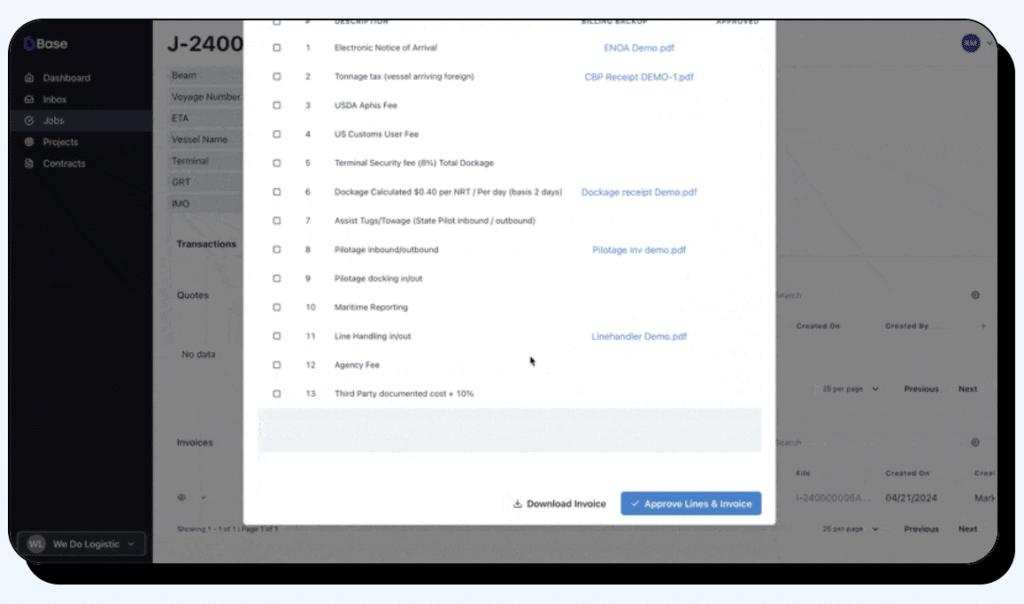
Base approaches port clearance documentation as part of the job record rather than something gathered after the call is finished. The goal is to keep the clearance story intact while the work is happening, so review later is routine instead of investigative.
Each port call in Base maintains a single document history where operational, regulatory, and financial records stay tied to the services and costs they support. This structure supports ensuring compliance with relevant laws and latest regulations reviewed by customs authorities and other government agency teams.
From an agent’s perspective, that shows up as a working checklist attached to every job.
For each port call, Base keeps track of:
- Arrival notices, customs declarations, and regulatory forms tied to the active ETA
- Service confirmations linked directly to charges such as pilotage charges
- Vendor invoices attached to the service they support, not stored separately
- Supporting documentation captured while the call is active
- Statements of Fact that reflect the actual job timeline
- Financial records that roll cleanly into the FDA without reconstruction
As work is recorded, charges remain connected to confirmations and vendor invoices. Financial review relies on what was documented during the call rather than rebuilt afterward. When the FDA is prepared, it reflects activity that was already logged and supported.
When ETAs change, related documents remain connected to the same job. Updates do not create parallel records or loose versions. That continuity helps goods arrive at their final destination with complete documentation and fewer follow ups from customs officials.
The result is a clearance process that mirrors how the call unfolded, supported by proper documentation that stands up to port, customs, and financial review without added explanation.
Conclusion on Port Clearance Documents
Port clearance documents carry more weight than most people outside the agent desk realize. They are the record that shows how a call was handled, how services were justified, and how costs were supported once questions start coming in. When that record is scattered, agents spend time explaining decisions instead of moving on to the next vessel.
A clearance process that stays connected to the job reduces follow ups from ports, customs authorities, and finance teams. It also makes review faster because the story of the call is already there, captured as the work happened.
Base gives vessel agents a single place where port clearance documentation, customs clearance records, and financial support live together at the job level. If you want to see how that changes clearance work in practice, reaching out to Base is the next step.
Key takeaways
- Port clearance depends on coordinated inputs from agents, vessels, principals, and authorities
- Customs clearance operates as a required component within the broader port clearance process
- Timing gaps and version drift cause most documentation issues
- A single continuous document trail matters more than formatting polish
Frequently Asked Questions
Are port clearance documents the same at every port?
No. Core categories are consistent, but formats, deadlines, and authority requirements vary by country and port.
Who is ultimately responsible for submitting clearance documents?
In most cases, the vessel agent coordinates submission, even when documents originate from the vessel or principal.
Why do FDAs get questioned during clearance reviews?
Questions usually stem from missing or unclear backup, especially when invoices and service confirmations aren’t clearly linked.
When should clearance documents be finalized?
Many are prepared before arrival, but the full package often isn’t complete until all services are performed and confirmed.
Can clearance documentation affect payment timing?
Yes. Incomplete or unclear documentation often delays approval and payment, even when services were performed correctly.