
Demurrage risk usually starts before anyone calls it demurrage. It shows up in a late berth update, a tug confirmation that takes too long, an ETA that keeps changing, a nearly complete document packet, or a principal asking for backup while the team is still gathering the proof.
Each issue may feel manageable during the call. Together, those signals can move a voyage from normal operating pressure into real cost exposure.
That is why Base created the Demurrage Risk Index.
The Demurrage Risk Index is Base’s proprietary 0–100 scoring method for measuring demurrage exposure during a live port call. It takes 12 operational signals and rolls them into one risk score that ops teams can explain to principals, finance, and management.
The message becomes much easier to deliver:
“Our Demurrage Risk Index for this voyage is 32. Here’s why. Here’s what we’re doing about it.”
Think of it like FICO for port-call demurrage exposure: one standardized score, backed by the job record, that makes risk easier to explain while the team still has time to act.
The Demurrage Risk Index: How it Works
At its core, the DRI translates live port-call conditions into a 0–100 risk score. The score is calculated from 12 vessel-agent operational signals: pre-arrival timing, document readiness, ETA accuracy, vendor lag, terminal congestion, laycan or laytime tightness, NOR accuracy, berth readiness, service confirmation, cargo readiness, clearance risk, and PDA-to-live-cost variance.
A low score means the voyage is tracking close to plan. A high score means exposure is building and the team needs to act, document, or align with the principal.
| DRI Score | Risk Band | What It Means |
|---|---|---|
| 0–24 | Low | The call is tracking within expected operational and cost ranges. |
| 25–49 | Watch | A few weak signals need attention before they turn into cost. |
| 50–69 | Elevated | Real exposure exists, and ops, finance, and the principal need a shared plan. |
| 70–100 | Critical | Exposure is material, time-sensitive, and likely to affect cost recovery or principal trust. |
Base customer aggregate benchmark: In Base aggregate customer data, voyages with DRI scores above 70 correlated with a [X%] chance of demurrage incurrence, compared with [Y%] for voyages scoring below 50. Scores above 70 also showed [Z%] higher PDA-to-FDA variance and [A%] longer cost approval cycles.
Those benchmarks connect the score to actual outcomes, which is what makes the Index useful as an operating standard.
The 12 Inputs behind the Demurrage Risk Index
The Demurrage Risk Index aggregates 12 signals. Each signal is measurable, job-tied, and connected to a specific source of exposure:
| # | Input | Data Feed | Measurement Spec | Risk Threshold |
|---|---|---|---|---|
| 1 | Pre-arrival notification timing | Job timeline, port notice records, outbound message logs | Time between required pre-arrival notice deadline and actual notice submission | Risk rises when notice is sent more than [X hours] late or inside the port-specific cutoff window |
| 2 | Document completion rate | Document packets, templates, required field status, certificates | Percentage of required documents complete by arrival minus 24 hours | Risk rises when completion falls below [X%] at T-24 or below [Y%] at T-12 |
| 3 | Pilot-station ETA accuracy | Vessel ETA updates, AIS/API feed, manual ops updates, pilot order | Variance between latest pilot-station ETA and actual arrival at pilot station | Risk rises when variance exceeds [X minutes] or when ETA changes more than [Y times] after pilot order |
| 4 | Vendor-confirmation lag | RFQs, vendor replies, work orders, POs | Time from vendor request to confirmed service acceptance | Risk rises when key vendor confirmation takes more than [X hours] or remains open inside [Y hours] of service window |
| 5 | Terminal congestion forecast | Terminal status updates, berth queue, port congestion data, prior port turnaround patterns | Expected berth delay versus planned berth window | Risk rises when forecasted berth delay exceeds [X hours] or queue position changes by [Y+] slots |
| 6 | Vessel laycan tightness | Charter terms, laycan window, voyage schedule, nomination data | Remaining buffer between estimated completion and laycan or commercial cutoff | Risk rises when buffer falls below [X hours] or below [Y%] of original planning margin |
| 7 | NOR tendering accuracy | NOR timestamps, SOF events, berth/arrival records, document attachments | Match quality between NOR tender time, supporting event data, and acceptance status | Risk rises when NOR timestamp conflicts exceed [X minutes], supporting proof is missing, or acceptance is disputed |
| 8 | Berth readiness variance | Berth assignment, terminal updates, cargo readiness, port authority notices | Difference between planned berth readiness and confirmed berth availability | Risk rises when berth readiness slips by more than [X hours] or changes after vessel arrival |
| 9 | Tug, lines, and launch confirmation status | Service orders, vendor POs, operational checklist | Confirmation state for time-critical movement services | Risk rises when any movement-critical service is unconfirmed inside [X hours] of planned operation |
| 10 | Cargo operation readiness | Cargo ops plan, terminal readiness, surveyor status, cargo documents | Readiness of cargo, terminal, surveyor, and required cargo paperwork | Risk rises when readiness is below [X%] at berth assignment or when cargo start is forecast beyond [Y hours] from all-fast |
| 11 | Port authority and customs clearance risk | Clearance checklist, port authority submissions, customs/immigration documents | Completion and acceptance status for regulatory steps tied to vessel movement or cargo ops | Risk rises when required clearance items remain pending inside [X hours] of arrival or when resubmission is required |
| 12 | PDA-to-live-cost variance | PDA, accruals, vendor quotes, POs, AP lines, expected standby charges | Difference between planned PDA cost and live expected cost | Risk rises when live cost exceeds PDA by [X%], or when unapproved exposure exceeds [$X] |
These inputs are weighted based on their observed relationship to demurrage and cost escalation across Base customer data.
Base customer aggregate benchmark: Across [N] port calls in Base customer data, the strongest leading indicators of demurrage exposure were [Input A], [Input B], and [Input C]. Calls where all three breached threshold showed a [X%] demurrage incidence rate, compared with [Y%] when none breached threshold.
For those who need the cost categories separated first, our guide to detention vs demurrage explains where terminal time ends, equipment time begins, and why both can affect port-call exposure.
How Base Calculates the Score
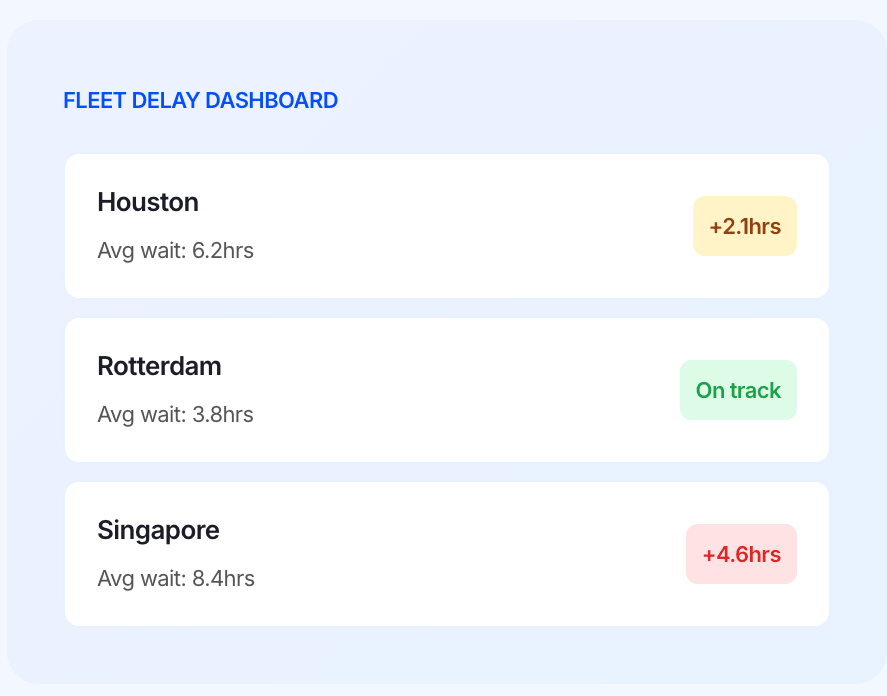
Each input receives a sub-score based on severity, timing, and confidence.
✓ Severity measures how far the signal sits from the expected operating range.
✓ Timing measures how close the call is to the moment where action becomes expensive.
✓ Confidence measures how complete the supporting proof is.
A late vendor confirmation six days before arrival may raise the score slightly. The same lag four hours before pilotage may raise the score sharply. A missing document with no owner assigned carries more risk than a missing document tied to a timestamped task, owner, and deadline.
Base then rolls the 12 sub-scores into one DRI score, giving the team a live number tied to real operating data.
The score is especially useful because it is tied to timestamped proof from the job record. In Base, the DRI reads from the same operational and financial trail the team already uses: timeline updates, vendor confirmations, document packets, NOR timestamps, PDA variance, approvals, and cost lines.
That keeps the score grounded in evidence instead of memory.
What DRI Bands Mean in Practice
The DRI band tells the team how urgently to act and what kind of response the voyage needs. A low score calls for routine monitoring. A watch score means the team should assign owners before the risk builds. An elevated or critical score should trigger principal communication, cost review, and tighter proof collection inside the job record.
The score is most useful when it leads to a specific action, so each band should tell ops what to monitor, what to document, and when to bring finance or the principal into the conversation.
DRI 0–24: Low risk
The call is tracking inside the expected range. Required documents are complete or on track, ETA variance is low, critical vendors are confirmed, and live costs remain close to PDA. The team should keep the job record current and monitor for new variance.
DRI 25–49: Watch risk
The voyage has early weak signals. A vendor may be lagging, terminal status may be unclear, or document completion may be close to the cutoff. The team should assign owners to each signal, confirm external dependencies, and prepare a principal update if the score keeps rising.
DRI 50–69: Elevated risk
The voyage has active exposure. The cost picture may be moving away from the PDA, critical timing may be unstable, or evidence may be incomplete. The team should notify the principal, attach the proof trail, update accruals, and document the action plan inside the job record.
DRI 70–100: Critical risk
The voyage has material exposure. Demurrage is likely or already forming, and the team needs tight coordination across ops, finance, vendors, and the principal. The team should treat the DRI as a live control room score: update the principal, preserve timestamps, confirm vendor terms, review NOR, attach all evidence, and keep finance aligned with expected recovery.
Base customer aggregate benchmark: In Base customer data, voyages scoring 70–100 showed [X%] higher likelihood of demurrage incurrence, [Y%] higher FDA dispute rates, and [Z%] longer time-to-approval than voyages scoring below 50.
Worked Example: Voyage DRI Score
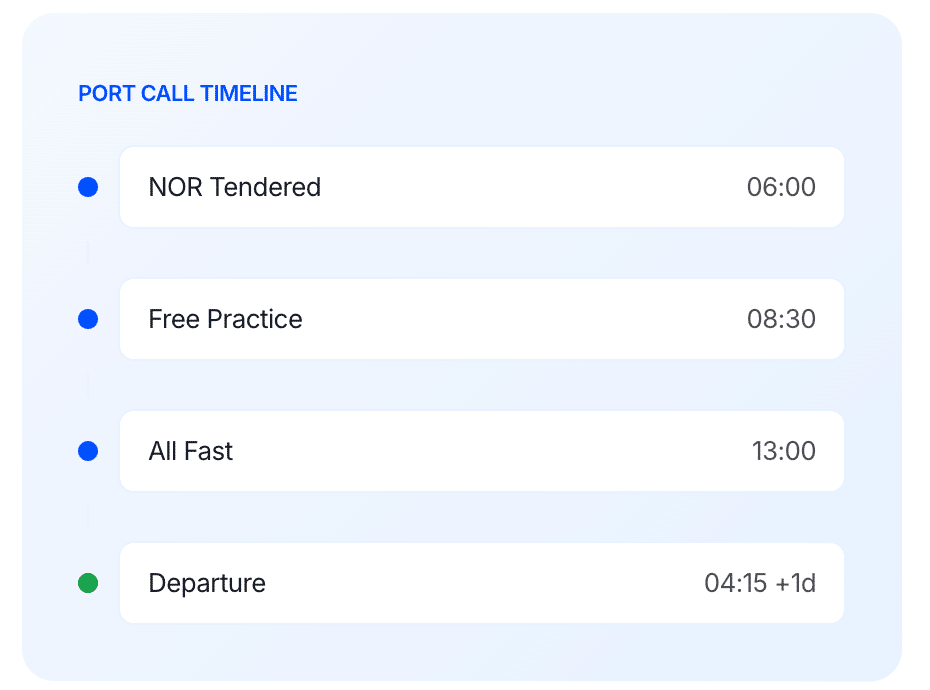
Looking at a worked score is where the Index becomes easiest to understand, because the you can see how small operating signals add up to a larger exposure picture:
Voyage: M/V Harbor Crest
Port: Houston
Operation: Inbound bulk cargo discharge
Initial PDA: $184,000
Scoring window: Arrival minus 36 hours through all-fast
Final DRI before berth: 68/100 — Elevated Risk
| Input | Voyage Measurement | Threshold | Score Impact |
|---|---|---|---|
| Pre-arrival notification timing | Notice submitted 5.5 hours after port-specific cutoff | >4 hours late | +7 |
| Document completion rate | 86% complete at T-24 | <90% | +5 |
| Pilot-station ETA accuracy | ETA revised 3 times; final variance 74 minutes | >60 minutes | +8 |
| Vendor-confirmation lag | Tug standby terms confirmed 9.5 hours after request | >8 hours | +6 |
| Terminal congestion forecast | Expected berth delay of 11 hours | >8 hours | +9 |
| Vessel laycan tightness | 14-hour buffer remaining | <18 hours | +7 |
| NOR tendering accuracy | NOR timestamp matched arrival log, but acceptance confirmation pending | Pending acceptance | +5 |
| Berth readiness variance | Berth readiness slipped from 0600 to 1500 | >6 hours | +8 |
| Tug, lines, and launch confirmation status | Lines confirmed; launch pending inside service window | Any critical service pending | +4 |
| Cargo operation readiness | Cargo docs complete; surveyor arrival pending | Surveyor unconfirmed | +3 |
| Port authority/customs clearance risk | No clearance resubmission required | Within threshold | +0 |
| PDA-to-live-cost variance | Expected live cost tracking 12.8% above PDA | >10% | +6 |
Final DRI: 68/100
Primary drivers: terminal congestion forecast, berth readiness variance, pilot-station ETA accuracy, laycan tightness, and PDA-to-live-cost variance.
Ops action plan:
- Notify the principal that DRI is 68 and rising due to berth and ETA variance.
- Attach terminal update, pilot ETA history, tug standby quote, and NOR support.
- Accrue expected standby and movement-service exposure against the job.
- Confirm launch service and surveyor arrival before the revised berth window.
- Re-score once berth readiness and NOR acceptance are confirmed.
This is where the Index earns its place in the workflow: it gives ops a defensible number, explains why the number changed, and records what the team did next.
How Principals, Management, and Finance use the DRI
Once the DRI exists, it becomes more than an ops metric. Principals use it to understand exposure, management uses it to compare performance, and finance uses it to prepare for recovery.
Principals use the DRI to see which voyage needs attention, which delay drivers are creating risk, and which evidence is already attached. They can review the score, the inputs behind it, and the action plan while the call is still active, which makes cost exposure easier to understand before the FDA lands.
Management uses the DRI to compare port-call health across teams, ports, vessels, and agents. A single score makes it easier to see which calls crossed into elevated or critical territory, which inputs pushed them there, and which teams brought exposure back down before FDA. Over time, management can spot repeated patterns, such as vendor-confirmation lag at a specific port, recurring berth-readiness variance at a terminal, or higher DRI scores for certain service types.
Finance uses the DRI to prepare for cost exposure earlier. When a score moves from 42 to 71, finance knows the cost position has changed and can review the likely drivers before vendor invoices arrive. The score points finance toward lines that need attention, such as standby, launch, tug changes, disputed NOR timing, unapproved vendor exposure, or PDA-to-live-cost variance.
| Stakeholder | What They Need to Know | How They Use the DRI |
|---|---|---|
| Principals | Which voyage is exposed, what is driving the exposure, and what the agent is doing next. | Review the score, risk drivers, attached proof, and action plan before the FDA lands. |
| Management | Which teams, ports, vendors, or terminals keep creating exposure. | Compare DRI patterns across calls and use the inputs to guide process changes. |
| Finance | Which costs are likely to move and what proof is needed for recovery. | Monitor DRI movement, update accruals, review variance, and prepare the proof pack earlier. |
The DRI gives each group a shared score with the level of detail that matches its role. Principals usually need the score, the drivers, and the plan; management needs patterns across many scores; finance needs the cost lines and proof behind the score. That shared structure keeps everyone aligned during the call and gives the team a cleaner record after the call.
Final Take on Demurrage Risk Index

The Demurrage Risk Index gives vessel agents a practical way to turn port-call risk into a number principals, management, and finance can use. The score gives the team a clearer way to explain exposure, assign action, preserve proof, and defend decisions when costs are reviewed.
When the DRI is visible during the call, demurrage risk becomes easier to manage before it becomes harder to recover.
To see how Base helps teams track exposure, preserve proof, and manage demurrage risk inside the live job record, explore Base’s demurrage management software.
Frequently Asked Questions
What is the Demurrage Risk Index?
The Demurrage Risk Index is Base’s 0–100 scoring method for measuring live port-call cost exposure before demurrage fees become a billing issue. It gives agents a clear way to explain risk during the shipping process, using operational signals such as ETA accuracy, document readiness, vendor confirmation, and PDA-to-live-cost variance.
How does the Demurrage Risk Index help vessel agents explain risk?
The Index gives ops teams one number they can bring to principals, management, and finance. Instead of describing exposure loosely, the team can show what changed, why the score moved, and what they are doing to avoid demurrage. That matters when demurrage charges are building because a delay, missing document, or vendor gap has started to affect the call.
How is the DRI different from a normal port-call checklist?
A checklist tells the team whether tasks are complete. The DRI shows how incomplete or late items affect cost exposure, including demurrage and detention fees, detention fees, and related risk signals across the job. It helps teams connect operational status to the likely financial impact of the voyage.
What kinds of delays can raise the DRI score?
The score can rise when there are customs clearance delays, customs delays, late vendor confirmations, terminal congestion, labor shortages, missing approvals, incomplete documentation, or other unforeseen circumstances that slow the vessel, cargo, or vendor workflow. It can also rise when containers remain at the terminal past planned milestones.
How does the DRI relate to port and terminal operations?
The DRI reads signals from the live job record, including berth readiness, vessel timing, document status, and updates from the port terminal. It helps agents see when terminal operators or local constraints may affect unloading operations, the unloading process, or the team’s ability to unload cargo in a timely manner.
What does the DRI tell principals?
Principals can use the DRI to understand which voyage is exposed, what is driving the risk, and what evidence the agent has already attached. That visibility is especially useful when a shipping line, shipping company, or principal needs to understand why demurrage occurs, when demurrage applies, and how the agent is protecting the cost position under the shipping contract.
How does the DRI help finance teams?
Finance teams use the DRI to see which cost lines may move before the final invoices arrive. A rising score can point to detention charges, demurrage and detention charges, storage fees, detention costs, or a pending demurrage invoice that may affect cash flow. It also gives finance a cleaner evidence trail for review.
Can the DRI help with container-related exposure?
Yes. The DRI can help teams track risk around a shipping container, container demurrage, an empty container, rail cars, or equipment that is not moving as expected. This is useful when the team needs to understand demurrage and detention exposure across international shipments, all your shipments, or broader global supply chains.