In this industry, you probably aren’t lucky enough to handle one port call at a time.
More often, you’ve got two, three, sometimes five vessels all moving toward the same window. One is waiting on berth confirmation, another is dealing with a shifting ETA, and a third has a vendor asking for final instructions while finance is already thinking about the PDA.
None of those calls exist in isolation. They overlap. They compete for attention. And they tend to get messy at the exact same moment.
What makes this job difficult is how quickly things change and how many moving parts have to stay aligned at the same time. If you’ve been doing this for a while, you already know there’s no perfect plan. But there are ways experienced agents keep things steady when everything starts stacking up. That’s what this blog is all about.
There’s a pattern to how those moments are handled. Once you start working that way, the pressure feels different. You’re still dealing with the same moving pieces, but the call stays under control instead of pulling you in five directions at once.
What Makes Managing Multiple Port Calls So Challenging

At a glance, it can look like a volume problem. More vessels equals more work. That part is true, but it’s not where most issues begin.
The real challenge is keeping track of multiple timelines that are all shifting at once. Each vessel has its own schedule and its own requirements. Vendors, terminals, and authorities all move at their own pace. Updates don’t arrive in a neat sequence. They come in pieces, often at the same time, and not always in a consistent format.
Updates don’t arrive in a neat sequence. Global schedule reliability has dropped below 40% at times in recent years, which shows how often timing breaks down across the industry. They come in pieces, often at the same time, and not always in a consistent format.
With one port call, you can usually keep a clear mental picture of what’s happening. You know what’s confirmed, what’s pending, and what needs attention next. Once you’re handling several, that picture gets harder to hold.
You’re no longer following one sequence of events. You’re tracking several in parallel. Changes that seem minor can affect multiple services across different calls. If something gets missed, it rarely stays contained to one vessel. That’s when the work starts to feel reactive instead of controlled.
And that’s why experienced agents rely less on memory and more on structure as the number of calls increases.
7 Tips for Handling Multiple Port Calls Without Losing Control
There isn’t a single tactic that makes this easy. What experienced agents do is build habits that keep things clear even when activity increases.
It starts with being able to see what’s happening across all calls, then deciding what matters most, and then keeping each part of the operation clean and contained. Here are our favorite tips for handling multiple port calls at once:
1. Keep Every Active Call Visible in One Place
The first thing that breaks under pressure is awareness.
When updates are spread across different threads and tools, you spend time figuring out what’s happening before you can even act on it. That delay adds up quickly when multiple vessels are involved. Agents who stay on top of several calls at once usually have a way to see all active vessels together.
That means being able to check status at a glance. Which vessels are approaching arrival. Which ones are waiting on confirmations. Which ones still have open items that need attention.
Once that picture is clear, decisions happen faster because you’re not hunting for context before making them. That clarity also makes it easier to decide where your attention should go next.
2. Reprioritize Constantly Based on Timing and Risk
No plan holds for long in port operations. An ETA shifts, a berth window moves, or a vendor flags an issue. What looked fine an hour ago can quickly become urgent.
Agents who manage multiple calls well don’t stick to a fixed port call plan. They keep adjusting based on what carries the most immediate risk. That could be a vessel nearing arrival without confirmed services. It could be a document deadline that affects clearance. It could be a timing issue that impacts more than one vendor.
The key is staying aware of how one change can affect more than one call.
3. Keep Each Port Call Structurally Separate
When multiple vessels are in motion, details can start to blur together. Instructions get mixed. Updates get applied to the wrong vessel. A document meant for one call gets referenced in another.
These are small errors on their own, but they create confusion that takes time to unwind. Agents who stay organized treat each port call as its own contained operation.
Each call has its own vendors, documentation, and timeline. When something changes in a port call, it’s updated within that specific context rather than tracked loosely across different places. That separation makes it easier to switch between calls without carrying over the wrong information.
4. Manage Vendor Overlap Proactively
Vendor coordination is where multiple calls often start to compete with each other.
Tugs, pilots, launch services, and terminals all have limited availability. When several vessels are calling around the same time, those limits come into play quickly. If vendor coordination is handled too late, you end up reshuffling bookings after conflicts and vendor disputes have already formed. That creates delays and forces adjustments across more than one call.
Agents who stay ahead keep an eye on how vendor commitments line up across all active vessels.
They’re not just confirming services. They’re checking how those services interact with each other. If two vessels are moving toward the same window, that gets addressed early. If availability looks tight, changes are made before it becomes an issue. That kind of coordination depends on having reliable, up-to-date information, which brings everything back to how updates are handled.
5. Centralize Communication to Reduce Missed Updates
Most problems don’t come from lack of effort. They come from missing something that was already communicated.
Updates arrive from the vessel, the terminal, vendors, and authorities. When those updates live in separate threads, it becomes harder to keep track of what’s current. You end up double-checking things that were already confirmed or overlooking details that were buried in a message.
Agents who handle multiple calls effectively reduce how scattered these updates become.
They keep communication tied to the specific call so that anyone reviewing that vessel can see the latest information in one place. That cuts down on repeated work and makes handoffs smoother, as well as limits ship agent’s liability. Once updates are easy to follow, the next pressure point becomes making sure documentation is accurate and ready when needed.
6. Keep Documentation Organized and Accessible
Documentation doesn’t just increase with each call. It increases in complexity.
Each port has its own requirements. Each client may expect a specific format. Pre-arrival forms, crew lists, port call reports and supporting documents all need to be correct and up to date.
When you’re handling several calls, the risk isn’t just volume. It’s using the wrong version or missing something that was already submitted. Agents who stay ahead of this keep documents tied clearly to each call and easy to retrieve.
Instead of searching through attachments or relying on memory, they know exactly where to find what they need. That reduces the chance of delays tied to paperwork and keeps the operation moving.
7. Track Financials Alongside Operations
Financial tracking often lags when operations get busy.
Each call generates costs, invoices, and supporting documents. When several calls are running at once, it’s easy for those details to pile up. Costs get recorded late. Backup gets harder to find. Invoices take longer to prepare because information has to be pulled together after the fact.
That delay creates friction later when finalizing FDAs and getting approvals.
Agents who manage this well keep financial tracking aligned with the operation as it happens. Costs are logged as they come in. Documents are attached while they’re still accessible. Nothing gets pushed to the end where it has to be rebuilt from scattered information.
At that point, each call is not just operationally complete, it’s financially ready as well. That’s where having the right system starts to make a noticeable difference.
Where a System Like Base Helps
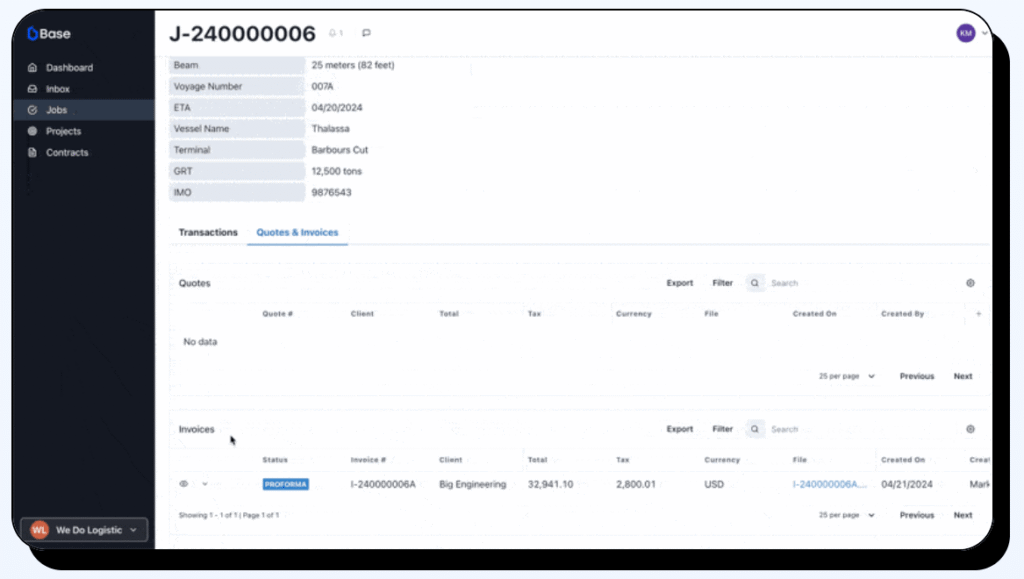
Everything above comes back to a few core needs. You need a clear view across all active calls, structure within each call, and information that stays connected instead of drifting across different tools.
That’s where a system like Base fits into the workflow.
Instead of tracking port calls across multiple systems, Base gives agents one place to see all active jobs while keeping each one organized as its own record.
Each vessel call has its own timeline, vendors, documents, and financials. Updates stay tied to the correct job. Vendor coordination happens within the same workflow used to manage the call. Financial tracking stays connected to the operation instead of being handled separately.
That removes a lot of the tension that shows up as the number of calls increases.
You’re no longer switching between tools or relying on memory to fill in gaps. The information you need is already where the work is happening. And that shift changes how the job feels day to day.
Conclusion: Control Is What Allows Agents to Scale
Handling multiple port calls comes down to staying clear on what’s happening across all vessels while keeping each call organized on its own.
When that clarity is in place, priorities are easier to manage. When structure is consistent, mistakes are less likely. When information stays connected, work doesn’t have to be repeated. That’s what allows agents to handle more calls without everything becoming reactive.
The workload stays demanding, but it becomes easier to manage. That’s what keeps operations steady, even when several calls start to overlap.
If this is something your team is dealing with every day, it’s worth taking a closer look at how your current workflow supports it. Base keeps each port call structured and visible while giving you a clear view across everything in motion. You can reach out to the team to see how it fits into your operation and what that looks like in practice.
Key Takeaways
- Managing multiple port calls is less about workload and more about keeping timelines clear and contained
- Agents perform better when they can quickly understand the status of every active vessel without searching for information
- Treating each port call as its own operation reduces avoidable mistakes when switching between vessels
- Missed updates are a common source of issues, especially when communication is spread across different channels
- Systems that connect operations, communication, and financials make it easier to handle higher volume without losing control
Frequently Asked Questions
How many port calls can a vessel agent realistically handle at once?
It depends less on volume and more on how well the work is structured. Some agents can manage several port call operations at once if each job is clearly defined, while others may struggle with fewer if coordination breaks down. The real factor is how effectively they’re optimizing port calls based on timing, risk, and available information.
What is the biggest challenge when handling multiple port calls?
The hardest part is keeping everything aligned across different parties involved. You’re coordinating with port authorities, vendors, and shipping companies, all of whom are operating on their own timelines. When those timelines shift, the port call process becomes harder to manage without clear visibility.
How do vessel agents prioritize between different port calls?
Agents focus on what will impact the operation most if delayed. Port calls play out differently depending on vessel type, cargo, and timing. For example, container shipping often has tighter schedules, so agents working with shipping lines may prioritize those calls differently than others.
Why is vendor coordination more difficult with multiple port calls?
Vendor coordination becomes more complex because many services overlap across calls. Tug operators, pilots, and terminal operators may be handling multiple vessels at once. When demand increases or port congestion builds, it becomes harder to keep port visits aligned without conflicts.
What role does documentation play in managing multiple port calls?
Documentation is tied closely to execution. Every step of cargo handling, including unloading cargo and compliance requirements, needs to be accurate. In maritime operations, missing or incorrect paperwork can slow things down quickly, especially when terminal operators require precise information before proceeding.
How do vessel agents avoid missing important updates?
Agents reduce missed updates by keeping communication tied to the specific port call instead of spread across channels. When different parties working on the same call are aligned, it creates a smoother operation. This is especially important in the maritime industry, where even small delays can impact the broader supply chain.